How to Build a SaaS SEO Content Strategy That Generates Pipeline

Most SaaS companies don't fail because they publish too little content. They fail because they publish the wrong content, in the wrong order, for the wrong buyers. Their roadmap starts with blog ideas instead of commercial intent. The result is traffic and very little pipeline.
This guide shows how to build an SEO content strategy for SaaS that prioritizes revenue, commercial pages, and buyer intent. It's a content system that compounds over time instead of a backlog of disconnected articles.
Why Most SaaS Content Strategies Never Generate Pipeline
Open a hundred SaaS content calendars and you'll find the same pattern. A list of blog topics loosely connected to the product, ranked by search volume, published on a weekly cadence, with no clear line back to a demo request or a signup. Traffic climbs. Pipeline doesn't move. Nobody on the founding team can explain why. This is the same gap we broke down in the eight leaks killing SaaS pipeline, and a broken content sequence is very often the root cause behind several of them at once.
Here's what's actually happening. The strategy started with publishing instead of planning. Someone opened a keyword tool, pulled a list of "high volume, low difficulty" terms, and called that a content strategy. Search volume became the filter for what mattered, so every keyword got treated as equally valuable, regardless of whether the person searching it had any intention of buying software. There was no commercial page strategy sitting underneath the blog, so even when content ranked, there was nowhere high-intent for that traffic to go. There was no publishing sequence, so pricing pages and comparison pages that actually influence buying decisions got built last, if they got built at all. And the whole operation got measured by traffic and rankings, two numbers that feel good on a dashboard and mean almost nothing to a founder trying to hit a revenue number.
A SaaS content strategy built this way isn't broken. It's incomplete. It optimizes for visibility instead of conversion, and visibility without a buyer at the other end of it is just noise.
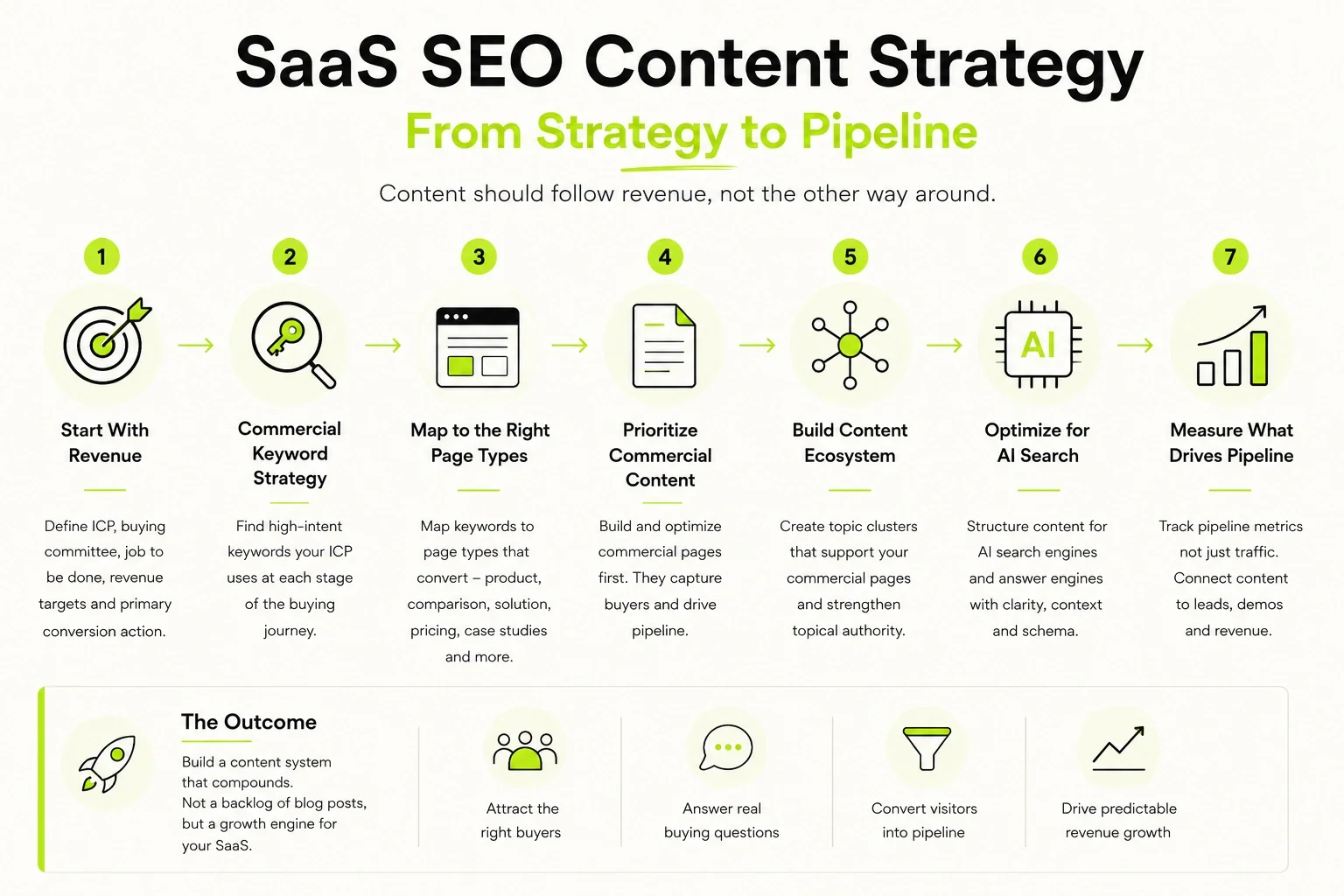
The rest of this guide walks through a different structure, one built around a single idea. Content should follow revenue, not the other way around. Every section in this guide builds one layer of that framework.
Start With Revenue, Not Keywords: Building an SEO Content Strategy for SaaS
Avoid opening keyword tools first. Keyword lists without positioning create the illusion of a plan. Before conducting keyword research, clarify the business parameters:
- Ideal Customer Profile (ICP): Define the exact team type, company size, and specific operational problem.
- Buying Committee: Identify all stakeholders. Complex B2B software purchases typically involve 6 to 10 decision-makers, requiring content that addresses multiple roles - exactly the complexity our enterprise SaaS SEO work is built around.
- Job To Be Done: Pinpoint the trigger that prompts a search for software.
- Sales Cycle Integration: Map where content needs to intervene during evaluation.
- Revenue Targets: Tie the content program directly to pipeline or booking figures.
- Primary Conversion Action: Match content to the specific model, whether demo, trial, sales contact, or self-serve signup.
- Domain age
- Existing authority
- Competitive intensity
- Technical SEO
- Commercial page coverage
- Publishing sequence
- Content quality
- Internal linking
- Content refresh cycles
The fastest-growing SaaS companies focus on the variables they control instead of waiting for the variables they don't.
Auditing Your Existing SaaS Content Before You Plan the Next Move
Most SaaS founders reading this already have content sitting on their site. Some of it is quietly working. Most of it is quietly doing nothing, and nobody has looked closely enough to tell the difference.
Before adding anything new, pull an inventory of what already exists. Look at your existing commercial pages, your feature pages, your product pages, and ask honestly whether each one is built to convert or just built to exist. Pull your Search Console data and find the pages getting real impressions but almost no clicks, since that's usually a title or meta problem, not a content problem. Find the pages sitting on page two or three of the results, close enough to page one that a focused update could move them. Look for cannibalized pages, cases where two or three URLs are quietly competing for the same query and diluting each other's authority. And flag the outdated pages, the ones referencing pricing, integrations, or product capabilities that no longer match reality. If organic traffic has actually dropped rather than just stalled, run it through a step-by-step traffic drop diagnostic before you touch the content plan.
For each page, there are seven honest outcomes to choose from.
| Outcome | Meaning |
|---|---|
| Keep | Already performing well |
| Refresh | Update outdated information |
| Expand | Add depth and coverage |
| Consolidate | Merge overlapping content |
| Redirect | Remove duplication and redirect |
| Remove | No strategic value |
| Create New | Content gap exists |
Keep the page if it's already doing its job and doesn't need attention. Refresh it if the core intent is right but the content has aged. Expand it if it's thin relative to what the query actually deserves. Consolidate it if it's splitting authority with another page targeting the same query. Redirect it if it no longer serves a purpose and its authority is better spent elsewhere. Remove it outright if it has no strategic value and isn't worth fixing. Or create something new if the gap genuinely isn't covered yet.
Build Your Commercial Keyword Strategy for SaaS SEO
Here's where most SaaS keyword strategy goes wrong before it even starts. Keywords get organized by volume, high to low, and the highest volume terms get treated as the priority. That approach makes sense for a media publisher chasing pageviews. It makes very little sense for a SaaS company trying to fill a pipeline.
The next three sections work as a single sequence, not three separate exercises. This section identifies commercial keyword opportunities. The next maps those keywords to page types. The one after that decides publishing priority. Each layer depends on the one before it.
The fix is to organize keywords by where they sit in the buying journey instead of how often they're searched. The framework for doing this is what we'll call the Revenue Keyword Universe. It's a hierarchy that moves from highest to lowest commercial intent, and gives every keyword in your SaaS keyword strategy a clear place in the buying journey.
Product terms sit at the top, the searches that use your product category by name. Right behind them, Pricing terms, a strong late-stage signal regardless of how the searcher phrases it. Then Comparison terms, where a buyer is actively choosing between two named products, followed closely by Alternative terms, searched by people already using a competitor and looking for a replacement. Feature terms come next, tied to a specific capability someone needs, then Use Case terms, describing a job the buyer is trying to get done. Industry terms follow, where a buyer wants proof the product works for companies like theirs, and Integration terms sit alongside them, often searched by technical evaluators checking compatibility. Free Tool terms sit lower on intent but can capture self-serve signups early. Problem terms describe the pain before the buyer even knows a solution category exists. And Educational terms sit at the base, the broadest top-of-funnel searches with the least immediate commercial value.
This is what a revenue keyword universe looks like. It's not a spreadsheet sorted by volume. It's a map of buyer intent, and every keyword you target should have a clear answer to one question. Where does the person searching this sit in the decision to buy software like mine?
Mapping SaaS Keywords to the Right Page Types
This is where the strategy stops being theoretical and starts producing pages that convert. Every keyword type from the hierarchy above needs to land on a page type built for that specific intent, with a CTA that matches how ready that buyer actually is.
| Buyer Intent | Keyword Type | Page Type | Primary CTA |
|---|---|---|---|
| Product | Product | Product Page | Demo |
| Feature | Feature | Feature Page | Demo |
| Use Case | Use Case | Use Case Page | Demo |
| Industry | Industry | Industry Page | Demo |
| Comparison | Comparison | Comparison Page | Trial or Demo |
| Alternative | Alternative | Alternative Page | Trial |
| Integration | Integration | Integration Page | Demo |
| Pricing | Pricing | Pricing Page | Contact Sales or Trial |
| Free Tool | Tool | Free Tool Landing Page | Signup |
| Documentation | Docs | Documentation | Product Usage |
| Educational | Informational | Blog | Internal CTA |
The mismatch that kills conversion rate almost never shows up in your rankings report. A page can rank well, pull in steady traffic, and still convert at close to zero because the page type doesn't match the intent behind the keyword. Someone searching a comparison term wants a comparison page built to convert, not a blog post that mentions the competitor in passing. Someone searching a pricing term wants pricing, not a feature overview that avoids the number. Get the page type wrong and you'll see healthy impressions sitting next to a conversion rate that never improves, and most teams never trace that back to the actual cause.
Why Commercial Content Should Come Before Educational Content
Using the hierarchy from the last two sections, here's the publishing order that follows from it.
- Product
- Pricing
- Comparison
- Alternative
- Industry
- Feature
- Use Case
- Integration
- Documentation
- Educational
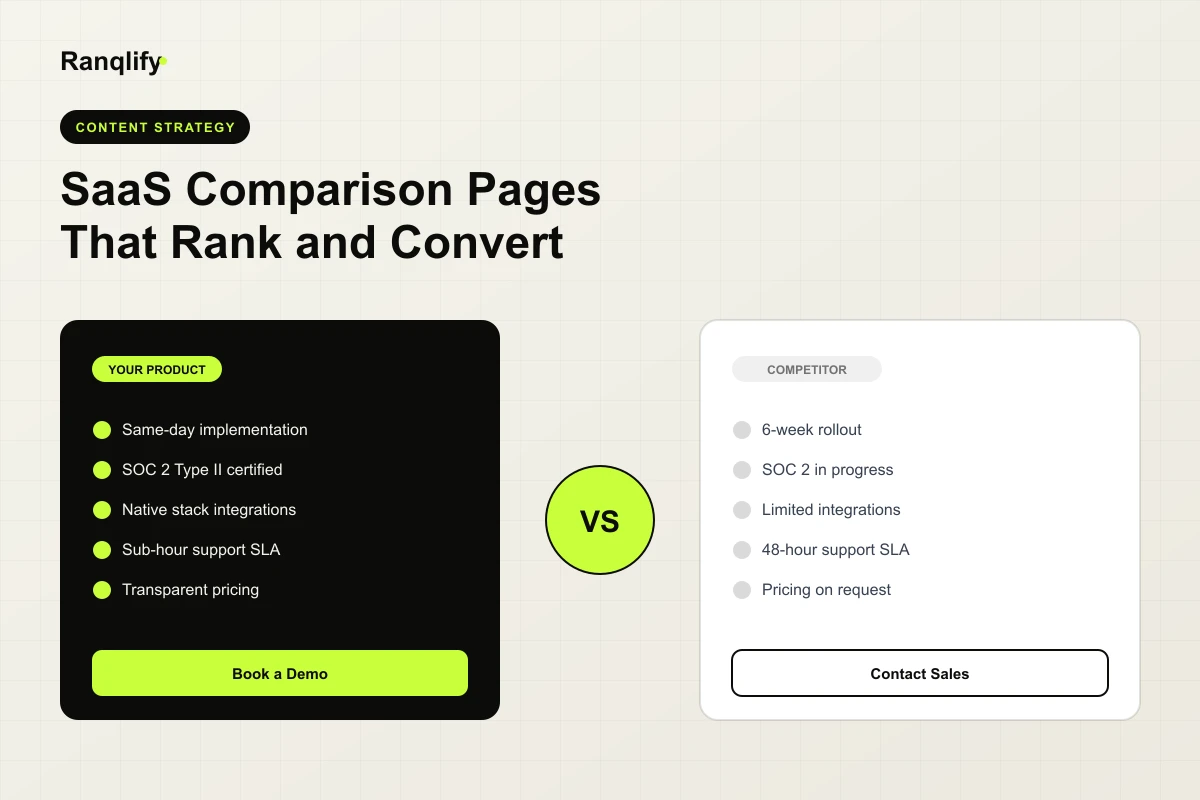
This runs against instinct for most founders, because educational content feels safer to publish first. It's easier to write, less exposed, and doesn't require making claims about your own product's edge over a competitor's. But educational content attracts attention. It doesn't convert it. A reader who lands on "what is customer churn" learns something and leaves. A reader who lands on a comparison page or a pricing page is actively deciding whether to buy, and that page either earns the demo request or loses it.
Many SaaS companies spend months publishing top-of-funnel educational content before building enough bottom-of-funnel commercial pages to convert buying-intent traffic. They generate visitors before they create destinations for those visitors.
Commercial pages convert. Supporting content, including the educational layer, exists to strengthen those commercial pages, not to stand alone as its own goal. A blog post about reducing churn should exist because it links into a use case page or a feature page that solves the exact problem it raises, not because "churn" had decent search volume. Build the pages that convert first. Build the content that supports them second. Reversing that order is the single most common reason a SaaS content marketing strategy produces traffic without pipeline.
Building a Commercial Content Ecosystem Around SaaS Topic Clusters
Traditional topic clustering puts a broad educational pillar page at the center, with supporting articles linking back to it. That model works reasonably well for a publisher. It works poorly for a SaaS company, because it puts an informational page at the center of the strategy instead of a commercial one.
Build SaaS topic clusters around commercial hubs instead. A commercial hub is a high-intent page, usually a product page, a use case page, or an industry page, sitting at the center of a cluster of supporting content that all exists to strengthen it. In practice, a full cluster also pulls in feature pages, integration pages, and documentation, alongside the flow below.
Every piece in that list has a job, and the job is to reinforce the hub, not to compete with it for authority. A case study proves the hub's claims with a real customer outcome. A comparison page captures a buyer actively weighing alternatives and routes them toward the hub. A template or statistics page earns links and citations that pass authority back to the commercial page it supports. This is what separates a real content ecosystem from a pile of unrelated blog posts. Everything points somewhere, and that somewhere is a page built to convert.
Preparing Your SaaS Content Strategy for AI Search
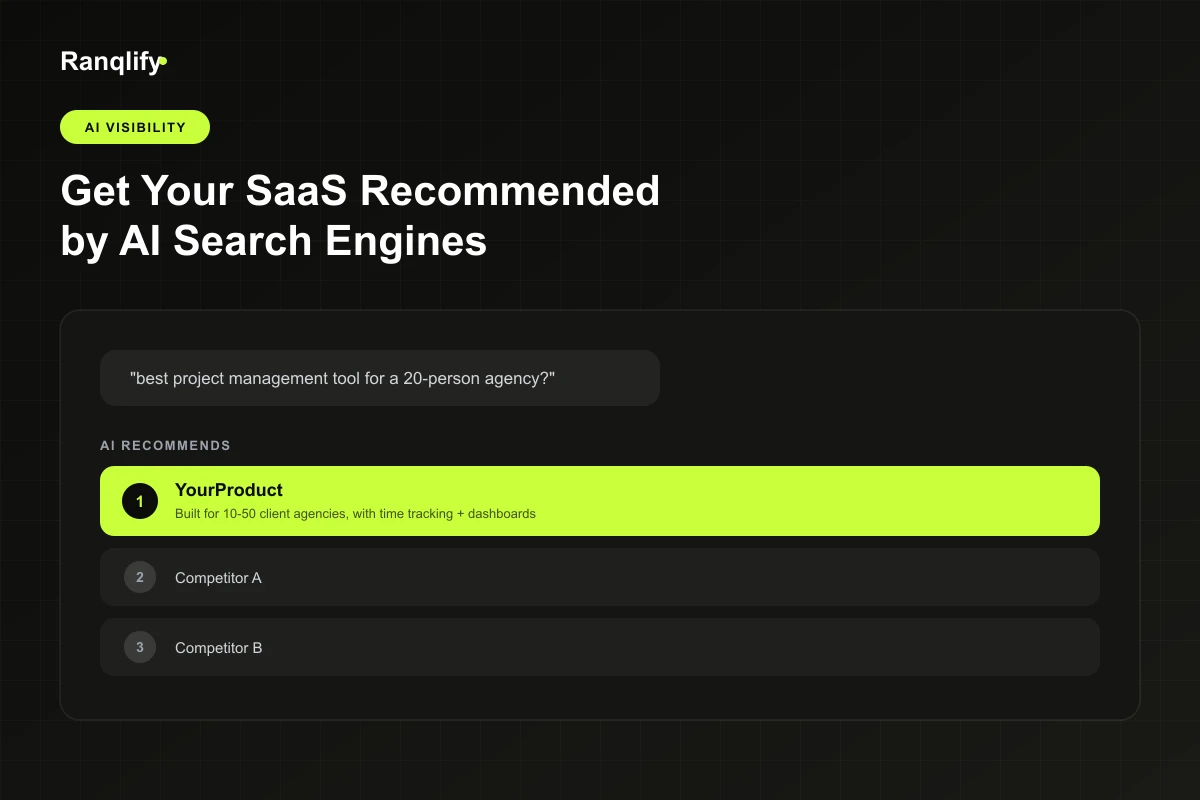
AI search doesn't require a separate strategy. It requires the same commercial content, built to be legible to a model deciding what to cite. That's the same principle behind getting your SaaS recommended by AI search engines, and AEO for SaaS exists precisely because the underlying content still has to do the work.
A few things matter more than most SaaS teams realize.
- Entity clarity: your product, your category, and your positioning stated plainly and consistently rather than buried in clever copy.
- Product specificity: naming features, use cases, and outcomes concretely instead of leaning on vague category language a model can't tie back to your product.
- Original research: data that didn't exist anywhere else before you published it, since models weight verifiable, attributable information over content that reads like a summary of something else.
- Tables: structured comparisons and data that are easier for a model to parse and extract than dense paragraphs.
- FAQs: answered directly and briefly, in the exact phrasing a buyer or a model would search.
- Verified citations: ground every claim in a primary source rather than a summary of one, since a model deciding whether to trust and cite your content weighs attributable data more heavily than restated conclusions.
The evidence on this is worth taking seriously. Ahrefs' analysis of citation overlap found that only about 12 percent of URLs cited by AI assistants like ChatGPT, Gemini, and Copilot also rank in Google's top ten for the same query. Ranking well still helps. It's no longer sufficient on its own.
The implication is straightforward. Ranking in Google increases the likelihood of being cited, but ranking alone is no longer enough. SaaS content must be structured for both search visibility and citation visibility. AEO isn't a separate discipline bolted onto SEO. It's what happens when commercial content is specific, well-sourced, and structured clearly enough for a model to trust it.
Building a Quarterly SaaS Content Roadmap and Content Calendar
The publishing priority from the previous section becomes a real SaaS content roadmap once it's mapped onto a calendar. Here's how that sequence typically plays out across four quarters.
| Quarter | Focus |
|---|---|
| Quarter 1 | Technical foundation, product pages, pricing, comparison pages |
| Quarter 2 | Industry pages, alternative pages, integrations, documentation |
| Quarter 3 | Case studies, templates, statistics, educational support content |
| Quarter 4 | Refresh, expand, optimize, consolidate |
Quarter one is the foundation. It's technical SEO for SaaS alongside the highest-commercial-intent pages, the ones with the clearest path to a demo or a trial. Quarter two builds out the next layer of commercial and technical evaluation content, the pages that come up once a buyer is seriously comparing options. Quarter three shifts toward proof and support, the assets that strengthen the commercial pages already live and start earning the citations and shares that help with AI search visibility. Quarter four is where most SaaS content calendars fall apart, because it's the quarter with no new pages to publish, only old ones to fix. Skipping it is how a strong content library quietly decays over eighteen months.
This is a SaaS content calendar with a reason behind every quarter, not a rotation of topics chosen because the calendar had an empty slot.
Common Mistakes That Derail a SaaS Content Marketing Strategy
- Publishing before the ICP and buying committee are clearly defined
- Starting the content plan with blog topics instead of commercial pages
- Chasing keyword volume instead of buying intent
- Never building comparison or alternative pages, leaving that traffic to competitors
- No publishing sequence, so commercial pages get built last or never
- Measuring traffic and rankings instead of demos, SQLs, and pipeline
- Letting commercial pages go stale while blog output keeps climbing
- Treating AI search as a separate initiative instead of an extension of the same commercial content
- Abandoning the sequence before it has time to compound - many SaaS teams restart their content strategy every quarter because the previous plan "didn't work," even though three months was never enough time to evaluate the results
How to Measure Whether Your SaaS SEO Strategy Is Actually Working
Split your measurement into two groups, and don't let the first group stand in for the second.
Leading Indicators
| Metric | What It Tells You |
|---|---|
| Rankings | Whether pages are gaining visibility for target keywords |
| Organic traffic | Whether visibility is converting to visits |
| Impressions | Whether your content is being surfaced for relevant queries |
| AI citations | Whether your content is being surfaced in AI-generated answers |
| Keyword growth | Whether your footprint across the revenue keyword universe is expanding |
Business Metrics
| Metric | What It Tells You |
|---|---|
| Demo requests | Whether commercial pages are converting |
| SQLs | Whether the leads content generates are sales-qualified |
| Pipeline | Whether content-sourced leads are entering real deal cycles |
| Opportunity value | Whether the pipeline content generates is worth pursuing |
| Revenue | Whether content is closing, not just opening, deals |
| Assisted conversions | Whether content is influencing deals it didn't directly source |
Leading indicators tell you the machine is running. Business metrics tell you whether it's working. A SaaS company can have rising rankings, rising traffic, and rising impressions for a full year and still have a content program that's failing, if none of that visibility is translating into demos and pipeline. Track both, but when the two disagree, believe the business metrics. Traffic is a leading indicator. Pipeline is the outcome.
On timeline expectations, it's worth being direct instead of vague. Early visibility improvements often appear within three to six months. Meaningful pipeline impact usually takes six to twelve months because rankings, trust, buyer consideration, and sales cycles compound at different speeds. Founders expecting a six-week turnaround are optimizing for the wrong outcome - for a fuller breakdown of what happens month by month, see the honest SaaS SEO timeline. Most successful SaaS SEO programs require a six-to-twelve-month commitment. Anything shorter is usually an experiment rather than a complete strategy.
A Practical SaaS SEO Content Strategy Template You Can Reuse
This is the asset worth saving. Build a working sheet with these columns and populate it using the revenue keyword universe from the keyword strategy section and the priority order from the publishing sequence section above.
| Topic / Keyword | Intent Level | Assigned Page Type | Priority Level | Owner | Production Status |
|---|---|---|---|---|---|
| [Target Query] | Product / Feature / Comparison | Product Page / Landing Page | Tier 1 / Tier 2 | [Name] | Planned / In Progress / Live |
Fill in Topic with the specific keyword or query. Fill in Intent using the hierarchy from the keyword strategy section: Product, Pricing, Comparison, Alternative, Feature, Use Case, Industry, Integration, Free Tool, Problem, or Educational. Fill in Page Type using the matrix from the mapping section above. Fill in Priority using the publishing order from the commercial-before-educational section, so commercial entries sit at the top of the sheet by default. Fill in Owner so every row has a named person accountable for it, since most SaaS teams operate with multiple contributors and an unowned row is a row that never ships. Fill in Status as Not Started, In Progress, Published, or Needs Refresh, and revisit that column every quarter as part of the audit process from earlier in this guide.
Used consistently, this single sheet replaces the blog idea list most SaaS companies build their content plan around, and it keeps every future page tied back to intent instead of inspiration.
Want your keyword hierarchy and publishing sequence mapped for you?
We build the revenue keyword universe and content roadmap as the first deliverable of every SaaS SEO engagement.
Frequently Asked Questions on SEO Content Strategy for SaaS
Conclusion: Turning SEO Content Strategy Into Predictable Pipeline
The biggest mistake SaaS companies make isn't publishing too little content. It's publishing the right content in the wrong order. The SaaS companies that win with SEO rarely publish the most content. They publish the right commercial assets first, then build supporting content around them. Traffic is a by-product. Pipeline is the goal.
- Content strategy starts with revenue and ICP, not a keyword tool - clarify buying committee, job to be done, and conversion action first
- Focus on what you control: technical SEO, commercial page coverage, publishing sequence, content quality, internal linking, and refresh cycles
- Audit existing content into seven honest outcomes before adding anything new: keep, refresh, expand, consolidate, redirect, remove, or create new
- Organize keywords by commercial intent, not search volume - Product, Pricing, Comparison, and Alternative terms carry the most weight
- Publish commercial pages before educational content - Tier 1 pages first, Tier 3 (educational) last
- Build topic clusters around commercial hubs, not educational pillar pages
- AI search rewards the same specific, well-sourced commercial content that converts human buyers
- Track leading indicators and business metrics separately, and believe the business metrics when they disagree