Multilingual SaaS SEO: A Practical Framework for International Growth

Most SaaS companies don't struggle internationally because they lack translated content. They struggle because they enter the wrong markets, localize the wrong pages first, and assume buyers search the same way everywhere they expand. If inbound demand or an investor conversation forced international expansion onto your roadmap, you do not need a lecture on why global growth matters. You need a clear sequence of what to do first, what to skip, and what will quietly sink the project if ignored.
This guide breaks down the multilingual SaaS SEO framework that avoids each of those mistakes. Every section maps to one stage of the sequence below.
Why Most Multilingual SaaS SEO Projects Fail
Most multilingual SEO projects don't fail because the team didn't work hard enough. They fail because the work happened in the wrong order, aimed at the wrong thing.
The most common mistake is translating pages instead of localizing the buying experience. A translated pricing page tells a French buyer what your product costs. It doesn't tell them why your product fits how French SaaS buyers evaluate vendors, what objections they'll raise, or what proof they need before they trust a foreign company with their stack. Translation changes the words. Localization changes the argument. That's the difference between translating a site and building a multilingual SaaS website that actually converts.
The second failure is choosing languages before markets. Teams pick German because "Germany is big" or Spanish because "it covers a lot of countries," then discover the demand, the competitive landscape, and the buying behavior look nothing alike across the countries that share a language. Market selection is a strategic decision. Language is just the delivery mechanism for that decision, and the next section covers how to sequence this correctly.
The third failure is reusing English-market keyword research across every locale, which assumes buyers everywhere search the same way in a different alphabet. They don't.
The fourth failure is publishing every language simultaneously, spreading a limited content budget so thin that no market gets the depth needed to actually rank or convert. The fifth is technical debt, mainly around hreflang and canonical tags, that silently tells Google to ignore half the localized pages a team just paid to build. The sixth is tracking translated page count as a success metric instead of pipeline or revenue by region, which rewards activity instead of results.
None of these are exotic mistakes. They're the default outcome of treating multilingual SEO as a translation project instead of a market entry strategy.
Choose Markets Before Languages
Language is a delivery mechanism. Market is the strategic decision. Get that order backwards and you'll spend a quarter localizing content for a country that was never going to buy. An effective SaaS international SEO strategy starts with scoring markets against clear criteria, not with picking a language off a map.
Before picking a language, score each candidate market against five factors:
- Existing customer signal. If you already have paying customers in a country, even a handful, that market has already voted. Organic demand beats every market research report you could commission.
- Demand data. Look at search volume for your core terms in-market, not just population size. A large country with low category search volume is a slower bet than a smaller one where buyers are actively searching.
- Competitive density. A market with three entrenched local competitors and strong brand loyalty is a harder, slower win than one where the category is still being defined.
- Localization cost. Some languages require a full linguistic and cultural rebuild. Others, particularly within the same language family or region, need far less lift to feel native.
- Revenue ceiling. Estimate the realistic contract value and volume in that market before committing engineering and content resources to it.
Every market gets scored on the same five factors before a single word gets translated.
| Factor | What It Tells You | Score (1-5) |
|---|---|---|
| Existing customer signal | Whether the market has already voted with real revenue | ___ / 5 |
| Demand data | In-market search volume for your core terms | ___ / 5 |
| Competitive density | How entrenched local competitors already are | ___ / 5 |
| Localization cost | How much linguistic and cultural rebuild is required | ___ / 5 |
| Revenue ceiling | Realistic contract value and volume in that market | ___ / 5 |
Score each candidate market one to five on these factors, even informally. A market that scores well on customer signal and demand but poorly on competitive density and localization cost is a different bet than one that scores the reverse, and the scoring exercise forces that trade-off into the open before you commit a content calendar to it. If you're already juggling multiple products, markets, or buying committees, this is the same discipline our enterprise SaaS SEO work is built around.
Build a Market-Specific Keyword Strategy
Translation is linguistic. Keyword research is behavioral. Running your English keyword list through a translator and calling it done conflates the two, and it's the single most common shortcut that quietly caps international traffic before it starts.
Native terminology differs even within the same product category. The German market might search for a functional description of what your software does, while the French market searches using an English loanword because that's simply the term the category adopted locally. Neither pattern is visible from an English keyword list, and both determine whether your page ever surfaces for the query a buyer actually types.
Commercial intent phrasing shifts by market too. How a buyer searches for comparisons, pricing, or reviews isn't a direct translation of the English pattern, it's a separate behavior shaped by how that market shops for software. A CRM company expanding into a new market, for example, might find that English-market buyers search comparison terms heavily late in the funnel, while a different market searches review-style terms earlier, before they've narrowed to a shortlist. That's illustrative of the mechanism, not a claim about any specific market's actual behavior, which is exactly why each language needs its own keyword research built from scratch rather than derived from the English list.
The practical takeaway is that every language you launch needs independent keyword research using in-market tools and in-market search behavior, not a translated spreadsheet.
Choose the Right Website Structure for International Growth
Choosing the right structure determines how much domain authority carries into new target markets. Three primary structural options exist for international sites.
- Subdirectories (example:
yoursite.com/de/): Inherit existing domain authority immediately. They require the lowest engineering effort, run on your primary infrastructure, and are the easiest for small teams to maintain. - Subdomains (example:
de.yoursite.com): Partially separate from main domain authority and require more setup work, but offer flexibility if a market needs different hosting or technical infrastructure. - Country-Code Top-Level Domains (example:
yoursite.de): Send strong local trust signals to users and search engines. However, they split domain authority completely, require separate hosting or business registrations, and multiply maintenance burdens.
For most resource-constrained SaaS teams, subdirectories are the ideal default. You retain existing SEO equity and avoid unnecessary infrastructure overhead. If strict data residency rules or local compliance laws apply, a ccTLD or subdomain earns its added cost.
Localize Commercial Pages Before Blog Content
This is a sequencing argument, and it's the one founders get backwards most often because blog content feels like the obvious multilingual SEO starting point. Blog content builds long-term authority. Commercial pages convert demand that already exists. A resource-constrained team should fund conversion before authority, because commercial pages capture buyers who are already searching for your category in-market right now, while blog content pays off on a much longer timeline. If your team has capacity for one localized blog post or one localized pricing page this month, the pricing page wins. It's closer to revenue, and it's the page a market-specific buyer is most likely to search for directly.
Build first → build next → build last. Revenue-closest pages come first because they convert existing demand fastest.
Priority 2 is usually where comparison pages earn their place in a localized site - they capture buyers close to a decision in-market, which is exactly the intent commercial pages are built to convert.
Build the Technical SEO Foundation for Multilingual Websites
This section runs more technical than the rest of the guide because it's answering an implementation question directly, and it's the section you'll likely reference repeatedly rather than read once. This is also where technical SEO for SaaS does the most work, since a single hreflang mistake can quietly undo a quarter of localization effort.
Language signals
Hreflang tells Google which language and regional version of a page to show a given user. In plain terms, it's how you prevent Google from showing your German page to a French visitor. According to Google Search Central's own documentation, every page in a hreflang set needs a link element for every language variant, including a self-referencing link back to itself, and the set of links must be identical across every version of the page.
x-default is the fallback hreflang value that tells Google which version to show when no other language or region matches the visitor. Skip it and visitors outside your defined markets can land on the wrong version by default.
Language switchers should be visible, crawlable links rather than JavaScript-only dropdowns or IP-based redirects. Google's own guidance notes that automatic redirects based on perceived location can prevent both users and search engines from ever seeing your other language versions, so a clickable switcher matters as much for indexation as for usability.
Hreflang is also the part of multilingual SEO most likely to be implemented wrong. A Search Engine Land study found that 31 percent of international sites contain conflicting hreflang directives, while another 16 percent are missing self-referencing tags, and either error alone can invalidate the entire setup. Validate hreflang on every deploy, not just at launch.
Indexation
Canonicals tell Google which URL is the authoritative version when near-duplicate content exists. Set canonicals correctly per language, never pointing a translated page's canonical back to the English original, or you'll tell Google to ignore the page you just localized.
- XML sitemaps should include hreflang annotations for each URL, which centralizes your language relationships in one place instead of scattering them across page headers.
- Crawlability means confirming translated pages aren't accidentally blocked by robots.txt, gated behind a language selector that requires a click to reach, or rendered in a way that hides content from crawlers until JavaScript executes.
Site architecture
- Link internally across locales so each language version has its own crawlable path through the site, not just a single link buried in a footer switcher.
- Keep URL structure consistent across languages so patterns are predictable for both crawlers and your own team maintaining the site.
- Watch for JavaScript rendering issues specifically on translated pages, since client-side rendering problems that are invisible on your primary market's pages can quietly block indexation on secondary language versions.
- Prevent duplicate content by making sure translated pages are genuinely different documents in Google's eyes, not the same HTML with a language toggle overlay.
Common Multilingual SaaS SEO Mistakes to Avoid
The first section covered the strategic pattern behind most failed multilingual SEO projects. This is the tactical checklist. Run your current project against it.
- Translating an existing keyword list instead of researching each market's actual search behavior independently
- Launching every target language at once instead of sequencing markets by priority
- Ignoring local competitors who already understand how that market buys
- Skipping hreflang validation after launch, and not catching conflicts or missing self-referencing tags until traffic quietly drops
- Localizing blog content before commercial pages, delaying the pages closest to revenue
- Measuring total organic traffic instead of regional pipeline, which hides whether a market is actually converting
If more than two or three of these apply to your current project, that's not a sign to start over. It's a sign of where to redirect the next sprint.
How AI Search Behavior Changes Across Markets
Multilingual SEO in 2026 goes beyond traditional search engine rankings. This is the AI Visibility stage of the framework at the top of this guide, and it's the section most likely to separate teams that win internationally from teams that only rank internationally. It covers how AI engines discover, retrieve, cite, and recommend products across different languages.
AI assistants retrieve information at query time from language-filtered pools. A buyer asking a question in German sees a different retrieval pool and recommendation shortlist than someone asking the identical question in English. As an illustrative example, not a verified case study, imagine a buyer in Berlin asking an AI assistant "what's the best [category] tool?" in German, and a buyer in Chicago asking the same question in English. The German-language answer draws from German-indexed documentation, German review platforms, and German-language mentions of your product, if any exist. If your product only has an English-language footprint, the model may simply have nothing in German to retrieve, and a competitor with even thin German documentation could take the recommendation slot instead. Worth being upfront about: AI retrieval systems aren't fully transparent, and this understanding is based on available public research rather than visibility into how any specific model's internals actually work.
Profound analyzed 3.25 billion AI citations across seven models and fourteen countries, filtering prompts by native language. Their research showed that query language directly alters which sources get cited and which domain types surface. The business implication is straightforward: a market where you rank well in Google but have no native-language documentation or in-market authority signals can still be functionally invisible in AI-driven recommendations for that same market. Different languages can create different AI recommendation environments, and a SaaS company optimizing only its English-language footprint is leaving that exposure unmanaged in every other market it competes in.
Winning international visibility doesn't require a dedicated localization team or an enterprise-sized budget. It requires optimizing the same practical layer you're already localizing, extended to AI discovery, which is what Answer Engine Optimization (AEO) is built for:
- Native documentation: Publish clear, structured product documentation in the target language, even a lean version, rather than none at all.
- In-market authority signals: Build presence on regional review platforms, local industry directories, and regional publications, starting with whichever few are realistic for a small team to maintain.
- Structured data: Format content clearly so AI models can extract facts, features, and pricing details accurately.
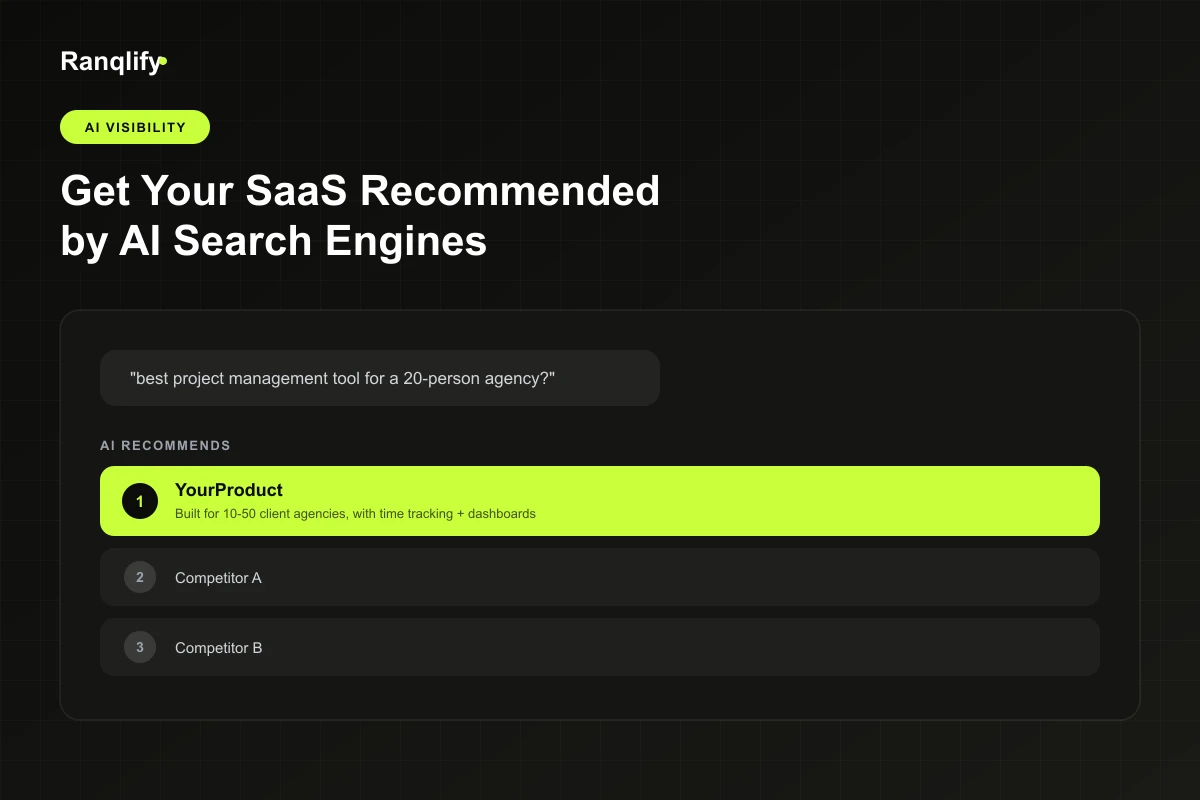
This is the same principle behind getting your SaaS recommended by AI search engines, applied per market instead of once. AEO isn't a separate initiative bolted onto each locale, it's AEO for SaaS extended to cover every language you compete in.
How to Measure International SEO Success
Translated page count is a vanity metric. It measures activity, not outcome, and it's the number most likely to make a struggling international SEO project look healthy on a dashboard.
Track these instead:
- Organic traffic by country and keyword visibility by market. This tells you whether the content is being found at all, which is the baseline signal before anything downstream matters.
- Demo requests, pipeline, and revenue by region. This is the number that actually justifies the localization investment. A market generating strong traffic but no pipeline is a targeting or conversion problem, not a content volume problem.
- Conversion rate by language. If your English site converts at twice the rate of your localized pages, that's rarely a translation quality issue alone, it's usually a signal that the localized experience isn't addressing how that market actually buys.
The central argument is simple. Regional pipeline and CAC reduction are the real scoreboard. A market with fewer translated pages and strong regional pipeline is outperforming a market with twice the page count and no revenue to show for it, no matter what the traffic dashboard says. And be realistic about pacing: multilingual SEO follows the honest SaaS SEO timeline of single-language SEO, so expect meaningful movement in months, not weeks.
Multilingual SaaS SEO Checklist for Global Growth
- Score candidate markets on customer signal, demand, competitive density, localization cost, and revenue ceiling before choosing a language
- Build independent keyword research for each market, not a translated version of your English list
- Default to subdirectories unless a specific regulatory or hosting reason justifies subdomains or ccTLDs
- Localize revenue pages first, then consideration pages, then documentation and blog
- Implement hreflang correctly, including self-referencing tags and x-default, and validate it on every deploy
- Keep canonicals, sitemaps, and internal linking consistent and crawlable across every locale
- Audit for the tactical mistakes above before assuming a market is underperforming for content reasons
- Optimize for AI-driven discovery in each market, including native-language documentation and in-market authority signals
- Measure regional pipeline and CAC, not translated page count
Want your market scoring and localization sequence mapped for you?
We build the market scorecard and localization roadmap as the first deliverable of every international SaaS SEO engagement.
Frequently Asked Questions on Multilingual SaaS SEO
Conclusion: Building a Scalable Multilingual SaaS SEO Strategy
Scaling internationally was never really about translation volume. It's about understanding how buyers in each market search, evaluate, and decide, then building a site and content strategy that meets them where they already are, one market at a time rather than all at once. The same sequencing discipline behind a strong SaaS SEO content strategy applies here, just run once per market instead of once for the whole company. That's the foundation of a multilingual SaaS SEO strategy that scales, and it's what turns a translated site into a genuine multilingual SaaS website.
That now includes AI search. Winning internationally in 2026 means earning trust in both Google and AI-driven discovery in every market you compete in, not just ranking translated pages in traditional search results.
If you're weighing which market to prioritize first, or trying to figure out whether your current international setup is a content problem or a technical one, that's a conversation worth having before committing another quarter of budget to it.
- Score candidate markets on customer signal, demand, competitive density, localization cost, and revenue ceiling before choosing a language
- Every language needs independent keyword research built from in-market search behavior, not a translated spreadsheet
- Default to subdirectories unless a specific regulatory or hosting reason justifies subdomains or ccTLDs
- Localize revenue pages first, then consideration pages, then documentation and blog - not the reverse
- Implement hreflang correctly, including self-referencing tags and x-default, and validate it on every deploy
- Query language changes which sources AI assistants retrieve and cite - different languages can create different AI recommendation environments
- AEO for international markets means native documentation and in-market authority signals, not a dedicated localization team
- Measure regional pipeline and CAC, not translated page count
'/%3e%3ccircle%20cx='600'%20cy='400'%20r='380'%20fill='url(%23glow)'/%3e%3c!--%20a%20single%20article%20page:%20unmistakably%20'content'%20-%20headline%20+%20body%20copy%20--%3e%3crect%20x='380'%20y='110'%20width='440'%20height='580'%20rx='32'%20fill='%23FFFFFF'%20fill-opacity='0.05'%20stroke='%23FFFFFF'%20stroke-opacity='0.18'%20stroke-width='3'/%3e%3c!--%20headline%20bar%20--%3e%3crect%20x='430'%20y='176'%20width='340'%20height='42'%20rx='21'%20fill='%23C9FF3A'/%3e%3c!--%20body%20copy%20lines%20--%3e%3cg%20fill='%23FFFFFF'%20fill-opacity='0.4'%3e%3crect%20x='430'%20y='262'%20width='320'%20height='16'%20rx='8'/%3e%3crect%20x='430'%20y='304'%20width='290'%20height='16'%20rx='8'/%3e%3crect%20x='430'%20y='346'%20width='310'%20height='16'%20rx='8'/%3e%3crect%20x='430'%20y='388'%20width='250'%20height='16'%20rx='8'/%3e%3c/g%3e%3c!--%20paragraph%20break%20--%3e%3cg%20fill='%23FFFFFF'%20fill-opacity='0.4'%3e%3crect%20x='430'%20y='440'%20width='270'%20height='16'%20rx='8'/%3e%3crect%20x='430'%20y='482'%20width='300'%20height='16'%20rx='8'/%3e%3crect%20x='430'%20y='524'%20width='190'%20height='16'%20rx='8'/%3e%3c/g%3e%3c!--%20pen%20badge:%20writing%20/%20creating%20this%20content%20--%3e%3ccircle%20cx='770'%20cy='620'%20r='58'%20fill='%23C9FF3A'/%3e%3cpath%20d='M746%20646%20L792%20600%20L804%20612%20L758%20658%20L742%20662%20Z'%20fill='%230C0C0A'/%3e%3cpath%20d='M786%20606%20L798%20618'%20stroke='%23C9FF3A'%20stroke-width='6'%20stroke-linecap='round'/%3e%3c/svg%3e)