
How to Create SaaS Comparison Pages That Rank and Convert

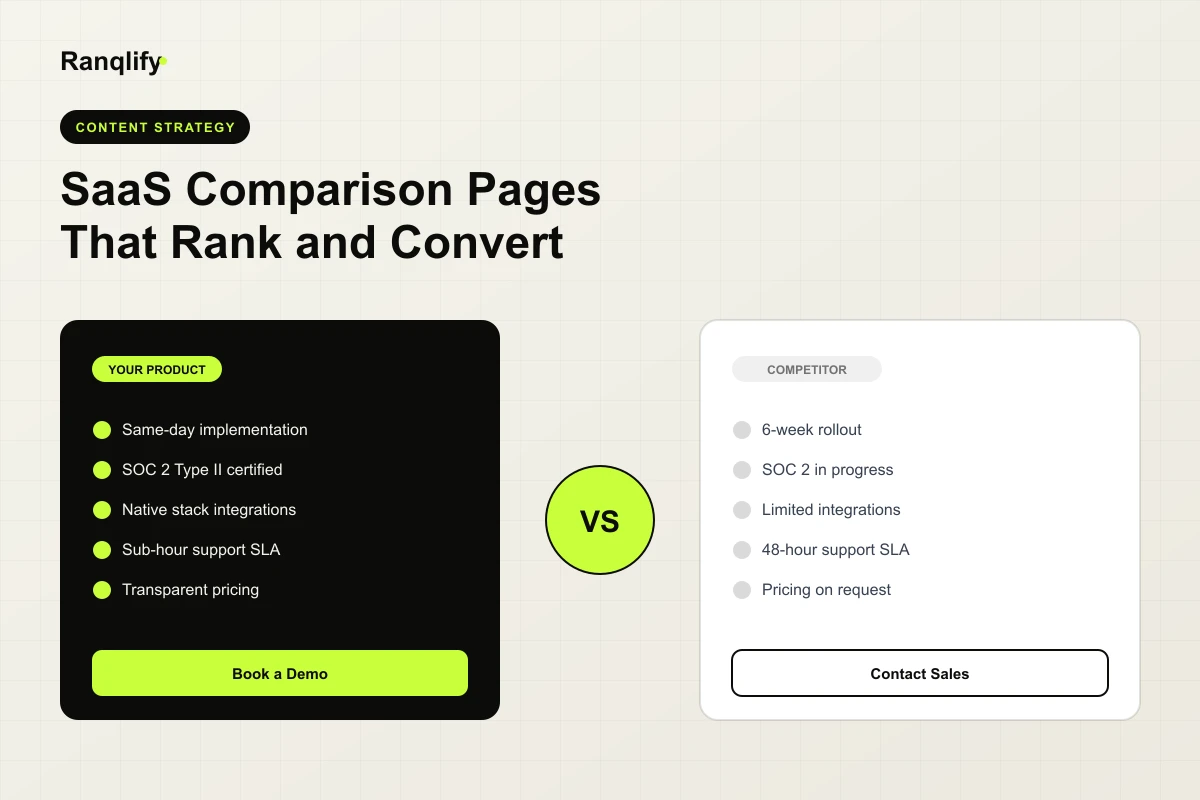
Your buyer has already made half their decision before they visit your site. They typed your competitor's name into a chatbot. They read three reviews on a software marketplace. They asked an AI tool to compare you against two other vendors, and it gave them an answer built entirely from other people's content. Your product got summarized by someone else's words.
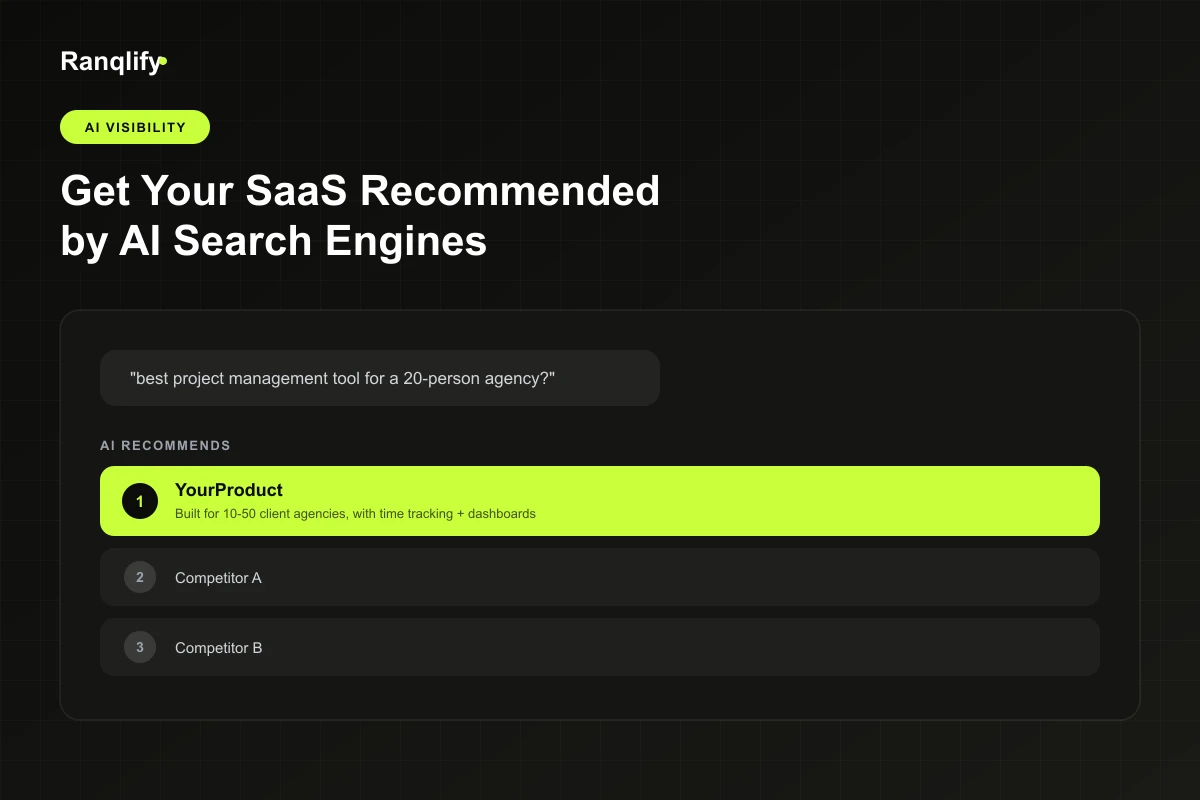
G2's The Answer Economy report found that 51% of B2B software buyers now start their research with an AI chatbot more often than with Google, up from 29% just seven months earlier. Buyers are compressing research into a single prompt that pulls from review sites, forums, and existing comparison content. If none of that content is yours, third parties control the narrative.
This is the part most SaaS founders miss. A comparison page is not a marketing nice to have. It is the one place where you get to answer the "how are you different" question in your own words, with your own evidence, before a competitor or a review site answers it for you.
Think about what happens without one. A prospect searches "your product vs their product." A review site or a competitor's own page shows up first. That page frames the comparison on their terms, not yours. They decide which features matter. They decide who wins. You are not in the room for the most important conversation in your sales cycle.
Why SaaS Comparison Pages Are a Commercial Growth Asset
A well built comparison page puts you back in that room. It does not replace your sales team. It gives them a document that already answered the objection before the call started. Treated correctly, a comparison page sits at the intersection of content that converts traffic into pipeline and content built for how AI systems now synthesize buying decisions.
- Same-day implementation
- SOC 2 Type II certified
- Native stack integrations
- Sub-4-hour support SLA
- Transparent pricing
- 4-6 week rollout
- SOC 2 in progress
- Limited integrations
- 48-hour support SLA
- Pricing on request
When Your SaaS Actually Needs a Comparison Page
Not every SaaS company needs a comparison page today. Building one because a competitor exists is how founders end up with a stack of thin, unranked pages that never earn a visitor. Build a comparison page when you see real demand signals, not assumptions.
- Your sales team is fielding the question on repeat. If reps hear the same "how are you different from X" question call after call, that question already has commercial weight. You have a transcript, not a guess.
- A competitor already outranks you for your own name. Search your brand name next to a known competitor. If a review site or the competitor's own page sits above anything you own, someone else is currently answering that question for your prospects. That's lost ground, and it's measurable.
- People are actually searching for the comparison. Tools like Ahrefs or Semrush will show whether people search "yourproduct vs competitor." If nobody's searching it, a comparison page ranks for nothing and converts nobody. Save the effort for a pairing people are actually typing into a search bar.
Most SaaS companies get this backwards. They build a page for every competitor they can name, then wonder why traffic never shows up. A comparison page is not a courtesy to your competitor. It's a page you build because a buyer is standing at a fork in the road and typing a question into Google or an AI platform. If nobody's at that fork, there's nothing to build yet.
How to Choose the Right Competitors to Compare Against
Once you know comparison pages are worth building, the next decision is which competitors earn one first. Most founders try to cover every name in their category. That spreads a small content team thin across pages that will never rank or convert. Prioritize on four factors.
Score each competitor against all four factors before committing to a page. Build for the top two or three, not the whole category.
- Customer overlap. If a competitor serves a completely different buyer, a comparison page between you does nothing. The competitors worth a page are the ones your actual prospects are evaluating you against right now, not the ones you consider peers on a slide deck.
- Deal size. A page that helps win a five thousand dollar annual contract is worth less time than one that helps win a fifty thousand dollar contract. Rank your competitor list by the deal size at stake, not by how often you think about that competitor.
- Frequency in live sales calls. The most honest signal you have. Pull your call recordings or ask sales directly which two or three competitors get mentioned constantly. The list is usually shorter than founders expect.
- Existing organic visibility. If a competitor already ranks for terms your buyers search and you don't, the gap compounds every month you wait. A comparison page against a competitor who owns that search real estate does double duty, capturing demand and closing the visibility gap.
Pick two or three competitors from this filter first. Build those pages properly before touching a fourth. Once you've identified the right competitors, the next challenge is building a comparison page that earns trust quickly and answers the questions buyers actually care about.
The Core Structure of a Comparison Page That Ranks and Converts
A comparison page has a job to do in a specific order. Get the order wrong and you lose the reader before they reach your strongest point.
Start with a clear verdict, not a long introduction. A buyer scanning this page in under thirty seconds should immediately understand who you are built for and how you differ. Bury this at the bottom and you lose the skimmers, who are most of your traffic.
After the verdict, give a short product overview. This is not your homepage copy repeated. It is a two or three sentence answer to "what does this company actually do," written for someone who may be comparing five vendors in one afternoon and cannot hold every detail in their head.
Next comes the feature comparison, ideally as a table. This is where buyers expect to see specifics side by side, not paragraphs. A table lets someone scan for the three features they actually care about instead of reading everything you offer.
Pricing comes after features, not before. A buyer needs to know what they are getting before they judge whether the price is fair. Reversing this order makes your product look like it is leading with cost instead of value. If pricing isn't publicly available, explain why and outline how pricing is typically structured instead of leaving buyers guessing.
Integrations and security follow pricing. For any SaaS buyer evaluating a tool that touches customer data or existing workflows, these two sections often decide whether the deal moves to procurement at all. Skipping them, or treating them as an afterthought, signals that you have not sold to a real enterprise buyer yet - the same rigor enterprise SaaS SEO engagements plan around from the start.
Use cases come next, showing the page is grounded in real scenarios rather than abstract claims. This is where you connect features back to actual jobs the reader is trying to get done.
Close with a clear call to action, not a generic "contact us." Tell the reader exactly what happens next, whether that is a demo, a free trial, or a specific next step tied to what they just read.
This order is not arbitrary. It mirrors how a buyer actually thinks through a decision, verdict first, then proof, then price, then risk, then fit, then action.
What SaaS Buyers Really Evaluate Before They Choose a Product
Marketers assume feature lists win deals. Buyers rarely say that in the room.
| Buyer Question | What They're Evaluating |
|---|---|
| Can we implement it quickly? | Time to Value |
| Is it secure? | Security & Compliance |
| Will it integrate? | Existing Tech Stack |
| Can we rely on support? | Support Quality & SLAs |
| Is it worth the investment? | Business Value |
- Ease of implementation. Usually the first real concern once a buyer is seriously considering a switch. A tool with more features but a six week rollout loses to a tool with fewer features and a same day setup, especially for a mid sized team without a dedicated implementation lead.
- Security and compliance posture. Comes up earlier than most founders expect, even for smaller deals. A buyer's IT or security lead will ask about SOC 2, data residency, and access controls before anyone discusses feature depth.
- Support responsiveness. Matters more than founders assume, particularly for buyers burned before by a vendor that disappeared after the contract was signed. Specific response time commitments carry more weight than a generic "we offer great support" line.
- Fit with an existing tech stack. Decides more deals than raw feature comparison. A buyer is asking whether your product plugs into the tools their team already lives in every day, not evaluating it in isolation.
None of this shows up if you're writing from a marketing brief instead of a sales call transcript. The gap between what marketers think matters and what buyers actually ask about is usually wide.
Writing Comparison Pages Buyers Actually Trust
Most SaaS comparison pages read like a lawyer wrote them on behalf of one side. That is the exact problem.
A buyer comparing five vendors in one afternoon has read four other comparison pages before landing on yours. They can spot a one sided page in seconds. The moment a page reads as pure sales pitch, the reader assumes everything on it is spin, including the parts that happen to be true.
The fix is not softer language. It is honesty with a purpose. Acknowledge where a competitor genuinely does something well. If they have a feature you do not, say so plainly, then explain who that feature actually matters for and why your product still wins for a different buyer. This is not weakness. It is the single fastest way to make the rest of the page credible.
Back every claim with something concrete. A screenshot, a specific number, a named integration, a security certification. Adjectives like "seamless" or "powerful" cost you nothing to write and earn you nothing in return, because every competitor's page uses the same words.
Keep the page current. A comparison page with a competitor's old pricing or a feature they shipped over a year ago tells the reader you have not looked at this page since it was published. That single detail can undo the credibility the rest of the page worked to build.
Most SaaS comparison pages fail here, not because the writer lacks skill, but because the incentive in most marketing teams is to make the home team look flawless. A buyer does not believe flawless. They believe specific and fair.
On-Page SEO Foundations for Competitor Comparison Pages
Technical and structural SEO ensures search engines and AI engines discover and surface your comparison content.
Intent Alignment
Ensure the page delivers a direct, side-by-side comparison. Avoid turning comparison pages into generic product updates or broad blog posts.
Clean URL and Title Architecture
Use direct URL patterns like yoursite.com/compare/yourproduct-vs-competitor to establish immediate context for crawlers and users.
Strategic Internal Linking
Link to comparison pages from high-intent assets like pricing pages and feature guides. Link outward from comparison pages to technical documentation and security portals to build topic authority across product surfaces.
Structured Data Implementation
Implement FAQ schema and product markup. Structured data helps search engines parse specific questions and answers, improving eligibility for rich results and direct AI answer extraction - the core mechanic behind AEO for SaaS.
The SaaS Comparison Page Trust Checklist
Five habits separate a comparison page buyers trust from one they bounce off. Run your pages against this checklist before publishing and during quarterly content audits.
| Avoid | Instead |
|---|---|
| One-sided claims | Balanced comparison |
| Old pricing | Quarterly reviews |
| Generic AI copy | Product-specific proof |
| Missing screenshots | Real evidence |
| Weak CTA | Clear next step |
A high-trust comparison page satisfies search intent and drives conversions by giving buyers the objective proof they need to decide.
What Great SaaS Comparison Pages Get Right
Real-world examples demonstrate how top SaaS brands implement these structural principles in practice.
Zendesk
Zendesk structures competitor comparison pages around direct value claims, side-by-side feature comparison tables, and structured, expandable FAQ blocks to address specific buyer objections directly.
Klaviyo vs. Mailchimp
Klaviyo takes a targeted approach against Mailchimp, building the page around clear e-commerce feature highlights and customer testimonials rather than exhaustive tables. The page gains credibility through industry-specific positioning, placing call-to-action buttons at key decision points throughout the narrative.
monday.com
monday.com utilizes a centralized comparison hub that lets visitors select specific competitors, such as Trello, Airtable, or Basecamp. This architecture scales efficiently across multiple category rivals while maintaining a consistent evaluation framework.
Each example succeeds by addressing user intent directly, providing clear proof points, and guiding the reader toward a logical next action.
Turning Comparison Pages Into Pipeline: What to Measure
Track commercial metrics to verify that comparison content drives pipeline rather than vanity traffic.
Rankings are only the entry point. What matters is how much of this funnel survives to qualified pipeline and revenue.
- Demo requests and trial signups. Track conversions originating directly from comparison pages. Configure attribution models to isolate demo requests and trial starts driven specifically by individual competitor pages.
- Assisted conversions. These matter as much as direct ones. A buyer might read your comparison page early in research, then convert two weeks later through a different channel. Last-touch attribution will make this page look like it did nothing, when it actually did the heaviest lifting.
- Pipeline contribution. The number that matters to a founder tracking revenue. Tie the page to the deals it touched and check whether those deals close at a similar or better rate than deals that never saw a comparison page.
- Traffic and keyword position. Still worth watching, but only as leading indicators. They tell you the page is being found, not whether it's doing its job. Treat them as a diagnostic, not a scoreboard.
Ultimately, comparison pages should be measured by their contribution to qualified pipeline and revenue, not rankings alone. Rankings create opportunities, but conversions prove business impact.
Answering the Questions Buyers and Founders Still Have
Making Comparison Pages Part of Your SaaS SEO Growth System
A comparison page operates as a core asset within a broader growth framework, connecting search intent, product positioning, and sales pipeline.
SaaS organizations that maintain comparison content through quarterly audits, updated competitor analyses, and internal linking strategies consistently convert search traffic into qualified deals over six to twelve months.
If existing comparison pages fail to produce qualified demo requests, audit keyword intent, review positioning accuracy, and evaluate page conversion paths to identify gaps.
Comparison pages don't win because they mention competitors. They win because they answer high-intent buying questions better than anyone else does. Maintained as living sales assets, not one-time blog posts, they become one of the highest-converting content types in a SaaS SEO strategy. If your comparison pages are still a gap, get your free SaaS SEO audit and see exactly where a competitor is currently winning the conversation instead of you.
- A comparison page lets you answer "how are you different" before a review site or competitor answers it for you
- Build pages only where demand signals exist - sales call frequency, deal size, customer overlap, and organic visibility
- Structure the page in the order a buyer actually thinks: verdict, proof, price, risk, fit, action
- Honesty about competitor strengths is what makes the rest of the page credible
- Comparison pages need the same on-page SEO rigor as any high-intent page - clean URLs, internal links, and FAQ schema
- Measure comparison pages by pipeline and revenue contribution, not traffic and rankings alone
'/%3e%3ccircle%20cx='600'%20cy='400'%20r='380'%20fill='url(%23glow)'/%3e%3c!--%20a%20single%20article%20page:%20unmistakably%20'content'%20-%20headline%20+%20body%20copy%20--%3e%3crect%20x='380'%20y='110'%20width='440'%20height='580'%20rx='32'%20fill='%23FFFFFF'%20fill-opacity='0.05'%20stroke='%23FFFFFF'%20stroke-opacity='0.18'%20stroke-width='3'/%3e%3c!--%20headline%20bar%20--%3e%3crect%20x='430'%20y='176'%20width='340'%20height='42'%20rx='21'%20fill='%23C9FF3A'/%3e%3c!--%20body%20copy%20lines%20--%3e%3cg%20fill='%23FFFFFF'%20fill-opacity='0.4'%3e%3crect%20x='430'%20y='262'%20width='320'%20height='16'%20rx='8'/%3e%3crect%20x='430'%20y='304'%20width='290'%20height='16'%20rx='8'/%3e%3crect%20x='430'%20y='346'%20width='310'%20height='16'%20rx='8'/%3e%3crect%20x='430'%20y='388'%20width='250'%20height='16'%20rx='8'/%3e%3c/g%3e%3c!--%20paragraph%20break%20--%3e%3cg%20fill='%23FFFFFF'%20fill-opacity='0.4'%3e%3crect%20x='430'%20y='440'%20width='270'%20height='16'%20rx='8'/%3e%3crect%20x='430'%20y='482'%20width='300'%20height='16'%20rx='8'/%3e%3crect%20x='430'%20y='524'%20width='190'%20height='16'%20rx='8'/%3e%3c/g%3e%3c!--%20pen%20badge:%20writing%20/%20creating%20this%20content%20--%3e%3ccircle%20cx='770'%20cy='620'%20r='58'%20fill='%23C9FF3A'/%3e%3cpath%20d='M746%20646%20L792%20600%20L804%20612%20L758%20658%20L742%20662%20Z'%20fill='%230C0C0A'/%3e%3cpath%20d='M786%20606%20L798%20618'%20stroke='%23C9FF3A'%20stroke-width='6'%20stroke-linecap='round'/%3e%3c/svg%3e)