How to Get Your SaaS Recommended by AI Search Engines

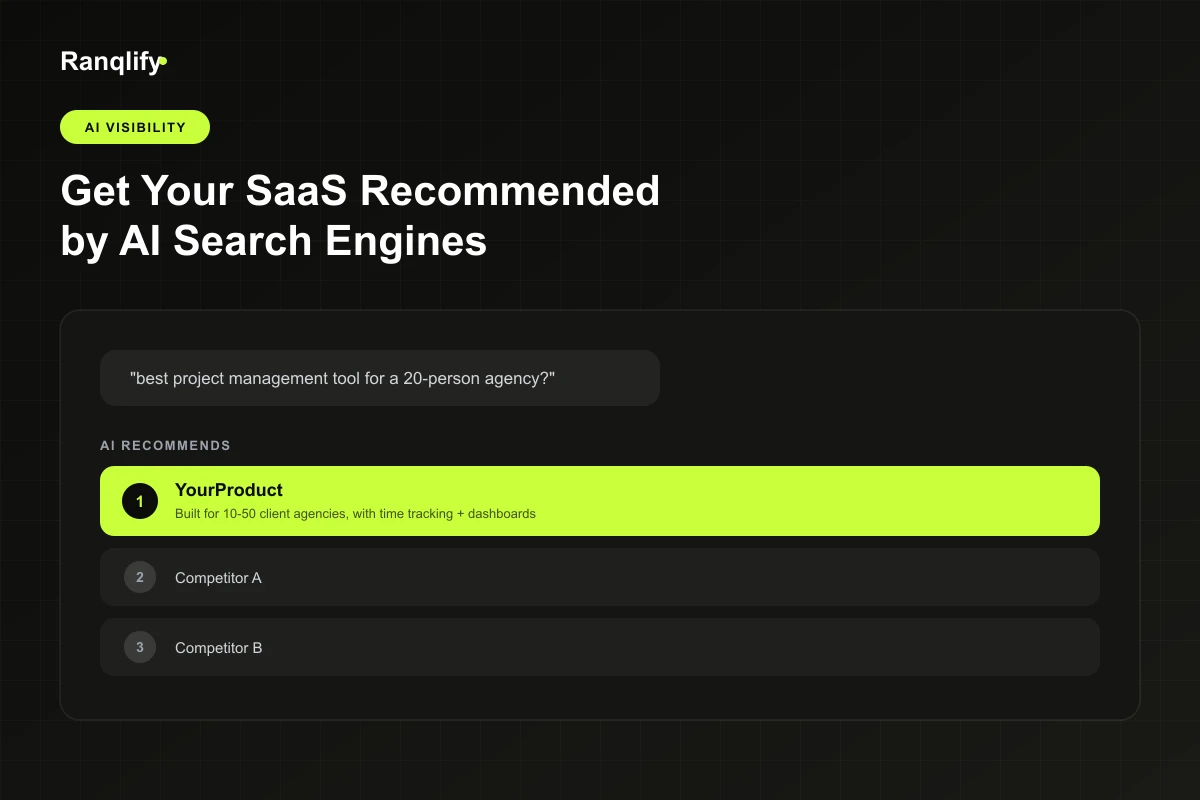
Your next customer probably didn't Google you. They opened ChatGPT, Claude, or Gemini, typed something like "best project management tool for a 20-person agency," and got three recommendations back. If your product wasn't one of them, you didn't lose a lead. You never existed in that moment at all.
That's the shift most SaaS founders are still catching up to. G2's 2026 The Answer Economy report found that 51% of B2B software buyers now start their research with an AI chatbot more often than with Google, up from 29% just seven months earlier. The same report found that roughly one in three buyers purchased from a brand they'd never heard of before, purely because an AI tool recommended it. That's not a ranking problem. That's a discovery problem, and it runs on a completely different set of rules than the SEO playbook most SaaS marketing teams have spent the last decade mastering.
We built this piece because we kept getting the same question from founders after sharing their competitive audits: "We rank fine on Google, so why do AI search engines keep recommending our competitor instead of us?" The answer is that Google rankings and AI recommendations are decided by different mechanisms, and being visible in one does not guarantee visibility in the other. This is a practical breakdown of how AI recommendations actually work, what decides whether your SaaS gets named, and the fixes to prioritize first if you have been invisible in these conversations without realizing it.
AI Search Is Changing How SaaS Buyers Discover Products
Think about the last time you needed a new tool. You probably didn't type a brand name into Google. You typed something closer to "best CRM for a bootstrapped startup," "HubSpot alternatives for small teams," or "AI meeting assistant that works with Slack." Those are the exact kinds of prompts your buyers are running through ChatGPT, Claude, Gemini, Perplexity, and Google's AI Overviews right now, dozens of times a day across your category.
Here is what makes this different from anything SaaS marketers have dealt with before: this entire conversation happens before your website gets visited, often before the buyer has ever heard your brand name. The AI tool synthesizes an answer from whatever it can retrieve and trust across the web, then hands the buyer a shortlist of two or three names. If you are not on that shortlist, you do not get a chance to make your case later. The buyer moves forward with the names they were given.
Compare that to how traditional search worked. A buyer typed a query, got ten blue links, and clicked through three or four of them, forming their own opinion by comparing what they read across multiple sources. That process gave every reasonably well-optimized competitor a chance to be seen, even if they weren't ranked first. AI search compresses all of that into a single synthesized answer. Fewer sources get surfaced at all, and the ones that do get surfaced carry outsized weight because the buyer never sees the alternative. This is exactly why AI search optimization for SaaS has to be treated as its own discipline rather than an extension of what you're already doing for Google. The mechanics of getting cited are different from the mechanics of getting ranked, and a product page that ranks on page one of Google can be completely absent from an AI answer for the same query.
How AI Search Decides Which SaaS Products to Recommend
Google publishes ranking factors. AI models don't publish a recommendation algorithm, and anyone who tells you they've reverse-engineered the exact formula is overselling certainty that doesn't exist yet. What we can say with confidence, because we've tracked it across client accounts, is that AI recommendation is never decided by one signal. It's decided by several signals compounding at once.
| Signal | Why It Matters |
|---|---|
| Product clarity | Makes it straightforward for AI to extract and quote factual details |
| Source credibility | Increases trust across retrieval databases |
| Brand authority | Reinforces recommendations with verified signals |
| Documentation | Provides factual proof of functionality |
| Technical SEO | Improves crawler retrieval and indexation |
| Consistency | Builds confidence in your messaging across sources |
No single signal decides a recommendation on its own. Weakness at any one stage reduces your odds of showing up at the end of the chain.
No single one of these guarantees a recommendation on its own. Weakness at any one stage of the retrieval-to-recommendation chain reduces your odds of showing up at the end of it. We cover our complete AEO methodology, including how we audit, prioritize, and implement these improvements for SaaS companies, in our AEO for SaaS guide.
Building Product Pages AI Can Understand
Start here, because this is the layer every AI recommendation ultimately traces back to. If a model is going to name your product, it needs a page it can quote from with confidence, and confidence comes from specificity.
Take a sentence like "an all-in-one platform for modern teams." That tells an AI model nothing it can extract and repeat. It's not wrong, but it's not usable either, because there's no concrete claim buried in it. Now compare that to "a project management tool built for agencies managing 10 to 50 client accounts, with built-in time tracking and client-facing dashboards." That second sentence gives a model something to hold onto. It answers a specific query about team size, industry, and feature set in language precise enough to quote directly in a synthesized answer.
The pattern holds across all three examples. Name the audience, name the problem, name the mechanism. That is what turns a sentence from marketing copy into something an AI model can lift and quote with confidence.
Run this audit across your product pages, feature pages, solution pages, industry pages, and pricing pages. For each one, ask whether a reader who has never heard of you could extract a specific, factual claim from the first two sentences. If the answer is vague positioning language, rewrite it. Name who the product is for, name the specific problem it solves, and name what makes your approach different in concrete terms an AI model can lift without having to interpret marketing language first. This is the single highest-leverage fix most SaaS teams can make, and it costs nothing but a content rewrite.
Creating Commercial Content AI Can Reference
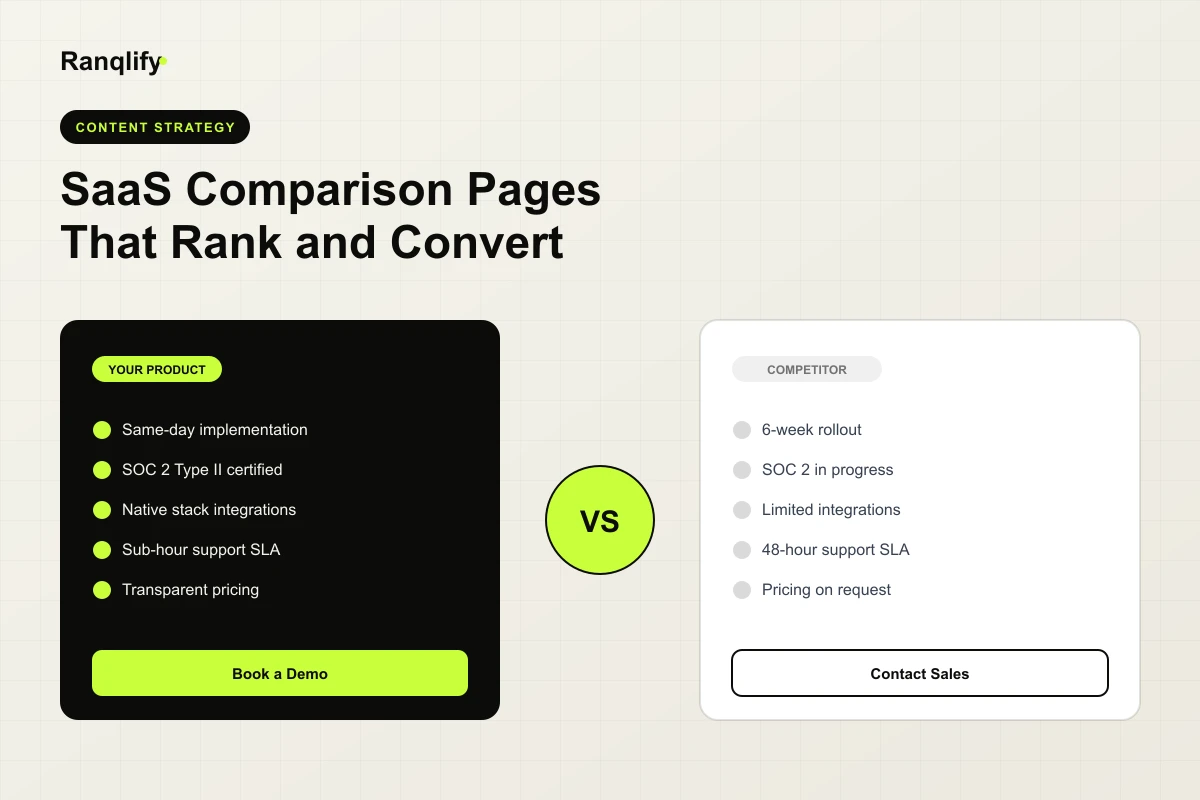
Once your core pages are specific enough to be quotable, the next layer is building the content types that directly answer the comparison and evaluation questions buyers ask AI tools. These include comparison pages, alternative pages, integration pages, template pages, use case pages, and industry-specific landing pages.
These pages matter more for AI visibility than almost any other content type you will produce because they mirror the exact structure of buyer prompts. Queries matching "X vs Y" pull directly from comparison pages. "Alternatives to X" prompts pull from alternative pages. "Does X integrate with Y" prompts pull from integration pages. If those pages do not exist on your site, the model fills the gap with whatever competitor or third-party source has them, handing that competitor the citation instead of you.
We have covered how to build these pages in detail in a separate breakdown titled How to Create SaaS Comparison Pages That Rank and Convert. The key takeaway here is straightforward: if comparison and alternative pages do not exist for your product against your top three competitors, you leave an open door for competitors in the exact conversations where buyers decide.
Why Documentation Is One of Your Biggest AI Visibility Assets
This is the section most founders skip past, and it's usually the biggest missed opportunity on the list. Your help center, product documentation, API docs, setup guides, tutorials, FAQs, and changelogs are quietly some of the most valuable AI visibility assets you own, and almost nobody treats them that way.
Here's the mechanism. AI models retrieve information more reliably from structured, unambiguous text than from marketing copy. Marketing pages are written to persuade, which means they're full of adjectives, superlatives, and framing that a model has to interpret rather than extract. Documentation is written to instruct. It states exactly what a feature does, exactly how a setup step works, exactly what an API parameter accepts. That factual density and structural clarity make documentation some of the easiest content on your entire site for a model to retrieve and cite with confidence.
Here is what that looks like in practice. A marketing page might say the platform makes onboarding seamless. A documentation page describing the same feature states that new users complete setup in three steps - connecting a data source, mapping fields, and setting a sync schedule - within five to fifteen minutes. The second version is what a model quotes directly when someone asks how long onboarding takes because it offers a clear fact rather than a subjective claim.
Your docs are also usually your most up-to-date content. Marketing pages get written once and forgotten. Documentation gets updated every time a feature ships, because if it doesn't, support tickets pile up. That freshness signal matters to retrieval systems that weight recency alongside relevance. If your documentation is thin, outdated, or locked behind a login wall that a crawler can't reach, you're hiding one of your strongest assets from the exact systems deciding whether to recommend you.
Building Trust Beyond Your Website
Everything so far has been about what you control on your own domain. AI models weigh that heavily, but they weigh independent, third-party validation even more, because a claim your own website makes about your product is a single, self-interested source. The same claim repeated across G2, Capterra, Product Hunt, GitHub, industry publications, podcasts, and press coverage becomes a corroborated signal across multiple independent sources, which is a fundamentally different kind of evidence to a retrieval system.
This is why review platforms matter so much for AI visibility specifically, not just for social proof. A strong G2 or Capterra presence gives a model a source it can cite that isn't you talking about yourself. A founder interview on a relevant podcast, a mention in an industry publication, a feature on Product Hunt, an active and well-documented GitHub presence if you're a developer tool: each of these is a separate node in a web of confirmation that your product exists, does what it claims, and is used by real customers. Digital PR and earned media do the same job at a larger scale, seeding your brand name and positioning language across domains you don't own but that the model already trusts.
If your entire online footprint is your own website and nothing else, you're asking an AI model to take your word for it. Build the third-party layer, and you're giving it a reason to believe you.
How Technical SEO Powers AI Visibility
Technical SEO is not a legacy concern reserved only for Google rankings. It serves as the foundation for AI visibility because AI systems cannot recommend content they cannot access or parse. This is the same technical layer covered in technical SEO for SaaS, and it matters just as much for AI crawlers as it does for Google's.
- Crawlability and Indexability determine whether AI crawlers can reach your pages in the first place.
- Internal Linking helps a model understand which pages are most important and how they relate structurally.
- Schema Markup translates your content into structured data a machine can parse without ambiguity, improving the accuracy of extracted claims.
- XML Sitemaps and Canonicals prevent models from retrieving duplicate or outdated content versions.
- Robots.txt controls crawler access, and misconfigurations can silently block AI crawlers.
- Page Speed ensures crawls complete successfully at scale without timing out.
One emerging addition to keep in mind: llms.txt is a proposed file format informing AI crawlers which site content is most relevant and how to interpret it, functioning similarly to robots.txt for traditional crawlers. It is an emerging standard rather than a universally adopted requirement. Not every AI platform currently reads or prioritizes it, so treat it as a forward-looking enhancement rather than a substitute for technical SEO fundamentals.
The takeaway is simple: none of the content optimization matters if the technical layer is broken. A perfectly written comparison page that a crawler cannot access will not exist to the model generating an answer.
Common Reasons SaaS Companies Get Overlooked by AI
Most SaaS companies invisible to AI recommendations are not failing because of one dramatic mistake. They fail because of gaps across key layers. Run this quick diagnostic to identify potential issues.
| If This Applies to Your Site | Action Step |
|---|---|
| Product pages rely on vague language | Review the Product Pages section to rewrite key claims |
| No comparison or alternative pages exist | Review the Commercial Content section to map competitor queries |
| Documentation is outdated or gated | Review the Documentation section to open and update help guides |
| Few third-party mentions exist | Review the Trust section to build external review profiles |
| Technical crawl errors remain | Review the Technical SEO section to resolve indexation issues |
If you are unsure where your gaps lie, performing a comprehensive audit is the best starting point.
Measuring Your SaaS AI Visibility
Track AI visibility using dedicated signals alongside your existing SEO metrics.
- Direct AI Mentions. Track how often your product gets named in AI responses for your core category prompts.
- Google AI Overviews. Monitor your brand presence within AI summaries on key search queries.
- Branded Search Growth. Watch for lifts in branded queries, which frequently rise after AI recommendations.
- AI Referral Traffic. Measure referral traffic originating from AI platforms in your analytics dashboard.
- Web-Wide Brand Mentions. Keep track of brand mentions across independent sites feeding trust signals to AI models.
AI visibility is a leading indicator, not the business outcome. What matters is how much of this funnel survives to revenue.
Focus on downstream business outcomes: organic demo requests, trial signups, and pipeline contribution. AI visibility serves as a leading indicator, not the final goal. If AI mentions increase while demo requests stall, the issue usually lies in your website conversion experience rather than the AI discovery layer - the same gap covered in why traffic doesn't always turn into pipeline. Treat AI visibility as a top-of-funnel metric that is valuable when it moves bottom-line pipeline.
The AI Visibility Readiness Checklist
Use this as a working audit. Check off what's genuinely done, not what's technically live but weak.
- Product pages. Every core page states a specific audience, problem, and differentiator in the first two sentences
- Feature pages. Each feature is described in concrete, quotable terms, not adjectives
- Comparison pages. Pages exist for your top 3-5 named competitors
- Alternative pages. Pages exist for "X alternatives" queries in your category
- Documentation. Help center, API docs, and setup guides are current, public, and crawlable
- Schema markup. Product, FAQ, and organization schema implemented and validated
- Internal links. Core commercial pages are linked from high-authority pages on your site
- Digital PR. At least one recent, relevant mention on an industry publication or podcast
- Brand consistency. Pricing, positioning, and feature claims match across your site, G2, and third-party listings
- Fresh content. No core commercial page is more than 6-12 months out of date
- Technical SEO. Crawlable, indexable, fast, with a validated sitemap and correctly configured robots.txt
Frequently Asked Questions on AI Visibility and AEO for SaaS
Becoming the SaaS Product AI Recommends
No single action guarantees that your SaaS gets recommended by AI engines. AI recommendations are earned through consistent, structured, credible signals delivered across your entire digital footprint so that models find the same corroborated details wherever they crawl.
Reframe your marketing approach: you are no longer just building a website that ranks, you are building a body of evidence that an AI model can trust enough to recommend.
If you want to identify your optimization gaps, get your free SaaS AI visibility audit to review what is holding your SaaS back from AI recommendations.
- AI recommendations run on a different mechanism than Google rankings - ranking well doesn't guarantee getting cited
- Vague positioning gives an AI model nothing to quote - name the audience, the problem, and the mechanism in concrete terms
- Comparison and alternative pages mirror the exact prompts buyers type into AI tools - a missing page hands the citation to a competitor
- Documentation is one of your highest-leverage, most underused AI visibility assets
- Third-party validation (G2, Capterra, GitHub, press) matters more to AI trust than anything your own site says about itself
- Technical SEO is the access layer - none of the content work matters if a crawler can't reach the page