How Much Does SaaS SEO Cost in 2026? Real Pricing & What to Expect


How Much Does SaaS SEO Cost in 2026
SaaS SEO in 2026 costs anywhere from $500 a month for a single freelancer to $50,000 a month for a full enterprise program. That range is wide on purpose. A five-person seed-stage startup and a $30M ARR platform company are not buying the same thing, even when both call it "SEO."
Based on aggregated pricing data from Ahrefs, Clutch, Upwork, Twine, and Glassdoor (see Sources), SaaS SEO pricing typically falls within the following ranges:
- Freelancer or contractor: $500 to $3,000 a month, or $50 to $150 an hour
- Small generalist agency: $1,500 to $5,000 a month
- Specialist SaaS SEO agency: $5,000 to $15,000 a month
- Enterprise SaaS SEO agency: $15,000 to $50,000+ a month
- In-house team: $200,000 to $430,000+ a year before tooling, estimated across four roles (manager, content lead, technical specialist, link builder)
Pricing ranges in this guide are based on aggregated 2025-2026 industry benchmark reports, freelance marketplaces, agency pricing studies, compensation databases, and SEO industry surveys. Actual pricing varies based on company size, technical complexity, market, and scope. Full references are listed in the Research Sources section.
SaaS SEO Pricing by Region
These ranges reflect US market rates, which most global benchmarking sources use as the baseline. Regional pricing shifts meaningfully:
- United States. The ranges above hold broadly across US markets, with senior and coastal talent trending toward the top of each band.
- United Kingdom. Specialist SEO retainers typically run £1,500 to £5,000 a month for SMEs, rising to £5,000 to £20,000+ for enterprise programs. Freelance engagements run £300 to £2,500 a month for lighter scopes. At current exchange rates, this tracks close to, but slightly below, equivalent US pricing.
- Western Europe. Region-wide benchmarking is thinner than for the US and UK, but rates in markets like Germany, the Netherlands, and the Nordics generally sit in a similar band to the UK, with premiums in high-cost cities and for specialist SaaS agencies.
- GCC (UAE, Saudi Arabia). SaaS-specific SEO expertise is scarcer in the region, so specialist agency and in-house pricing tends to land at or above US enterprise rates, even for mid-market SaaS companies. Founders here often bring in Western agencies for this reason.
Treat regional figures as directional. Always request a detailed proposal based on your website size, technical complexity, and business goals rather than budgeting from averages alone.
What moves a company from the bottom of that range to the top isn't luck. It's site size, technical debt, how many products or ICPs you're targeting, and how competitive your category is - the factors section below breaks that down in full. For now, the tiers.
SaaS SEO Pricing Broken Down by Service Tier
Price alone tells you almost nothing about what you're buying. A $2,000-a-month freelancer and a $2,000-a-month agency retainer can produce wildly different outcomes. Here's what each tier actually is, not just what it costs.
Freelancer or Contractor
$500 to $3,000/mo, or $50 to $150/hr
- Best fit
- Pre-seed to seed-stage companies needing narrow execution rather than strategy
- What's included
- Usually one specialist covering either content or technical work, rarely both - such as a single writer producing two to four articles monthly or a consultant running periodic audits
- When it works
- You already have a content strategy and need hands to execute it, or you need a one-off technical audit and have engineering resources to implement fixes internally
- When it fails
- You expect strategy, technical implementation, and content production from one person working part-time. SEO requires too many moving parts to compound into real growth under a single contractor.
Small Specialist Agency
$1,500 to $5,000/mo
- Best fit
- Early revenue SaaS companies needing multiple skill sets without the budget for a full program
- What's included
- A small team of two to four people covering content and basic technical SEO, often serving multiple industries alongside SaaS
- When it works
- You need consistent content output and technical health oversight for a simple product and buyer persona
- When it fails
- Your buying committee is complex, your sales cycle is long, or your category requires content written by a subject matter expert. Generalist agencies default to e-commerce or local business playbooks that fail to convert software buyers.
Specialized SaaS SEO Agency
$5,000 to $15,000/mo
- Best fit
- Growth-stage SaaS companies post-seed through Series B with clear product-market fit
- What's included
- End-to-end growth strategy, bottom-funnel commercial content, technical SEO, and Answer Engine Optimization (AEO) for AI search engines
- When it works
- You have product-market fit and need a partner who understands software metrics without month-long onboarding periods
- When it fails
- You are pre-product-market-fit or your ICP shifts monthly.
Enterprise SaaS SEO Agency
$15,000 to $50,000+/mo
- Best fit
- Multi-product or platform companies with several buyer personas and large internal marketing teams
- What's included
- Dedicated pods of five or more specialists, deep reporting infrastructure, and parallel workstreams across products or regions
- When it works
- Internal complexity requires dedicated external coordination across multiple product lines
- When it fails
- You pay enterprise rates for a single-product SaaS company that does not require large-scale coordination.
In-House Team
$200,000 to $430,000+/yr for a four-person team (manager, content lead, technical specialist, link builder), plus enterprise tooling, analytics, and AI platforms - typically $3,000 to $5,000 a month depending on the stack
- Best fit
- Companies where organic search is a proven channel requiring full-time internal product integration
- What's included
- Complete control over hiring, prioritization, and process without agency margins
- When it works
- You have 12+ months of runway to recruit and ramp a team, and organic search has already proven pipeline impact
- When it fails
- You use an in-house hire as your initial SEO test. Ramp times of 6 to 9 months create an expensive feedback loop for unproven channels.
| Tier | Cost | Best Fit | Team Size | Strength | Limitation |
|---|---|---|---|---|---|
| Freelancer | $500 to $3,000/mo | Pre-seed to seed | 1 | Low execution cost | No strategy layer |
| Small agency | $1,500 to $5,000/mo | Early revenue | 2 to 4 | Broader skill mix | Generalist playbook |
| Specialist SaaS agency | $5,000 to $15,000/mo | Growth stage | 4 to 8 | SaaS-specific strategy | Requires stable ICP |
| Enterprise agency | $15,000 to $50,000+/mo | Multi-product | 8+ | Manages high complexity | Overkill for single product |
| In-house team | $200,000 to $430,000+/yr | Proven channel | 3 to 5 | Full operational control | 6 to 9 month ramp time |
The SaaS SEO Investment Ladder
Most SaaS companies move through provider types as they grow, though this is a typical progression, not the only valid path.
- Pre-seed / Seed → Freelancer or small generalist agency
- Seed / Series A → Small specialist agency
- Series A / Series B → Specialist SaaS SEO agency
- Series B+ / multi-product → Enterprise agency or in-house team
Stage is the starting filter, not the whole answer. Two companies at the same funding stage can sit at different rungs because of technical debt, competitive density, product complexity, or how many ICPs they're serving - the factors section below covers these in full. A Series A company with three ICPs and a messy legacy site may need Tier 3 capability before a Series B company with one clean ICP does.
What You Actually Get at Every Price Point
Retainer size dictates resource capability rather than raw output. Here is how core operations scale across tiers.
- Technical SEO depth. Freelancers and small agencies provide periodic audit checklists for your engineers to execute. Specialist and enterprise tiers deliver ongoing optimization and direct implementation inside your CMS or code repository - the core of technical SEO for SaaS.
- Strategy vs. production. Lower tiers produce content against basic search volume metrics. Specialist and enterprise tiers build strategy around buyer journeys and high-intent commercial terms.
- Bottom-funnel pages. Comparison, alternative, and use-case pages require positioning knowledge. Specialist tiers treat these conversion assets as core deliverables, whereas lower tiers omit them.
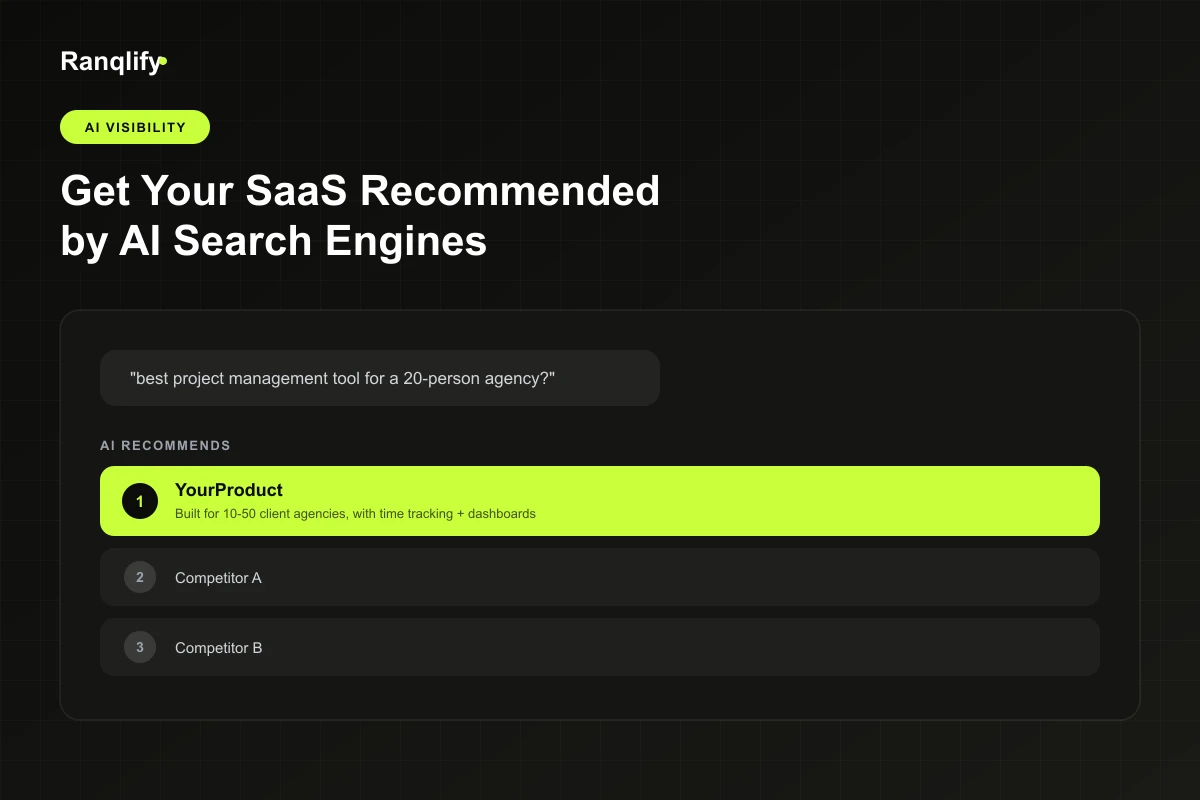
- AI search visibility. Appearing in ChatGPT, Perplexity, and Google AI Overviews requires AEO for SaaS. Lower tiers lack repeatable workflows for LLM optimization, whereas specialized agencies build AEO into baseline programs.
- Link building. According to Editorial.link's 2025-2026 pricing survey of SEO professionals, high-quality backlinks average $509 each. Dedicated link-building retainers commonly run into the thousands of dollars monthly on top of standard content programs.
- Reporting. Lower tiers track rankings and traffic. Specialist tiers track pipeline attribution and closed-won revenue impact.
At a glance: freelancers and small agencies execute against a scope you define; specialist and enterprise agencies build the scope for you and report on pipeline, not just rankings.
The Real Factors That Drive SaaS SEO Pricing Up or Down
Two companies can pay the same tier and get very different scopes because of what's underneath the retainer.
- Website size and existing content volume. A site with 20 pages needs a different starting investment than one with 400 pages of aging content that needs auditing and consolidating first.
- Technical debt. Migrations, slow load times, poor crawlability, and messy information architecture all add cost before content work can even start paying off.
- Product complexity. A single product with one clear use case is far cheaper to cover than a platform with multiple modules, each needing its own content and technical treatment.
- Competitive density. A category with a handful of players is cheaper to compete in than one where five well-funded competitors are already publishing aggressively.
- Number of products or ICPs. Every additional buyer persona or product line multiplies the content and strategy work required.
- International or multilingual needs. Each additional market usually means separate keyword research, separate content, and sometimes separate technical setup.
- Growth expectations and timeline pressure. Wanting meaningful results in three months instead of nine almost always means paying for more resourcing to compress the timeline, not a shortcut to the same outcome.
Hidden Costs Most SaaS SEO Agencies Don't Mention
- SEO tooling. Ahrefs, Semrush, and enterprise analytics platforms are bundled in specialist agency tiers but billed separately by lower-tier providers.
- Content scaling. Technical SaaS content commonly runs in the range of $0.15 to $0.50 per word, rising higher for specialized technical subject matter experts.
- Engineering time. Technical audits require internal dev resources unless the agency handles direct CMS execution.
- Link building add-ons. Often billed as a $1,000 to $3,000 monthly add-on at lower tiers.
- Content refreshing. Older SaaS content often requires quarterly updates to remain competitive, especially comparison pages, pricing pages, and AI-focused content.
Choosing the Right SaaS SEO Pricing Tier for Your Stage
- Pre-seed to Seed: Tier 1 or Tier 2. Hold budget if product-market fit or ICP definition is unsettled.
- Series A to Series B: Tier 3. Invest in a specialist agency to capture active category demand once ICP and positioning settle.
- Enterprise and Multi-Product: Tier 4 or Tier 5. Deploy enterprise agency resources or build internal teams when search is a proven channel requiring tight product integration - see enterprise SaaS SEO for what that coordination looks like in practice.
Why Founders Overpay (and Underbuy)
Most pricing mistakes in SaaS SEO aren't about the number on the invoice. They're about what the number is actually buying.
- Choosing the cheapest proposal over the strongest capability. A lower quote often means less strategic thinking per hour, not just less overhead. You're not comparing two prices for the same work, you're comparing two different scopes of work at two different prices.
- Buying traffic instead of pipeline. Rankings and sessions are easy to report on and easy to feel good about. They're also disconnected from revenue unless the content targets buyers who convert, not just searchers who click - the same trap covered in why SaaS sites get traffic but not pipeline.
- Hiring before product-market fit. Content built around an unstable ICP gets rebuilt once positioning settles. That's paying twice for the same ground, whatever tier you're buying at.
- Expecting results within 60 days. SEO compounds; it doesn't switch on. A provider who promises fast wins is either underselling the timeline or overselling low-value keywords that won't hold.
- Confusing content production with SEO strategy. Publishing volume without a system behind it - search intent mapping, internal linking, technical health, positioning - produces pages, not growth.
- Comparing retainers instead of business outcomes. A $2,000 retainer and an $8,000 retainer aren't on the same scale unless you're measuring what each one is expected to produce, not just what each one costs.
The fix isn't spending more by default. It's being precise about what you're actually trying to buy before you compare price tags.
What Results to Expect From Your SaaS SEO Budget
Organic compounding requires four to eight months for initial pipeline traction, with competitive keywords taking six to twelve months.
What Delaying the Right SEO Investment Costs You
Founders often frame the SEO pricing decision as "how much does this cost." The more useful question is "what does waiting cost?"
- Lost pipeline. Every month without a working organic channel is a month of pipeline that has to come from paid acquisition or outbound instead, both of which get more expensive as a company scales.
- Competitors continue earning authority and backlinks. While a company holds off, competitors already active in the category keep publishing, keep earning links, and keep building the topical authority search engines use to rank content. That gap doesn't stay static; it widens.
- Lost market share. Category-defining comparison and alternative pages get harder to rank for once a competitor has already earned the backlinks and topical authority. Waiting doesn't preserve the opportunity; it hands it to whoever moves first.
- AI search platforms increasingly reference established brands. ChatGPT, Perplexity, and Google AI Overviews tend to surface brands with existing authority and content history, not brands that start building visibility later. Delaying SEO delays AEO readiness at the same time.
- Organic authority compounds over time. Backlinks, content depth, and topical relevance build on each other. A company publishing consistently for twelve months has an authority base a late-starting competitor cannot replicate in the same window, regardless of budget.
- Rebuilding poor content. Content published without strategy usually needs to be rebuilt later, not just refreshed. That's a second cost stacked on top of the first.
- Delayed organic growth. Because SEO compounds, a six-month delay doesn't cost six months of results. It costs six months plus the ramp time needed to catch back up to where the compounding curve would have been.
- Delayed SEO means prolonged dependence on paid acquisition. Companies that never build an organic channel stay dependent on paid acquisition, where costs per lead typically rise over time as auction competition increases.
Recovering later is usually more expensive than investing earlier. Catching up to a competitor's accumulated authority typically costs more in time, content volume, and link building than building that same authority would have cost from the start.
This isn't an argument for spending before you're ready. The tier-selection guidance above is clear that pre-PMF spending is usually premature. It's an argument for not treating "not yet" as a cost-free decision once the ICP is stable.
SaaS SEO Pricing Questions Founders Ask Most
Why the Cheapest SaaS SEO Agency Isn't the Smartest Investment
Price is the easiest thing to compare and the worst thing to decide on. A $1,500-a-month agency and an $8,000-a-month agency aren't the same product at different volumes. They're often different products entirely.
The better filter is capability. Can they write commercial content a technical buyer won't bounce off of? Do they understand your competitive landscape well enough to build comparison pages that convert instead of just rank? Do they have a real, demonstrable process for AI visibility, not just a slide that mentions it. And critically, are they thinking in systems, meaning a repeatable process that compounds, rather than a grab bag of tactics renewed every month because nothing is actually building on the last month's work.
A cheap agency that gets your rankings moving but never touches pipeline has still cost you something. It's cost you the months you spent thinking SEO doesn't work, when what actually happened is you bought the wrong version of it.
Before You Sign Anything, Run Through This
- Does the pricing reflect a system built for SaaS, or a generic package
- Can they show commercial content that's driven pipeline, not just traffic
- Do they have a real process for AI search visibility
- Is reporting tied to business outcomes or just rankings
- Does the contract length match how long you're willing to wait for results
Before comparing retainers, compare systems. The right SEO partner shouldn't just explain what you'll pay - they should explain exactly how that investment becomes pipeline. Use this guide as your benchmark whenever you evaluate agencies or in-house hiring.
If you're weighing your options and want to see what a SaaS-specific system looks like in practice, Ranqlify's SaaS SEO services page walks through how the approach differs from a general agency retainer.
Research Sources
The pricing benchmarks, salary estimates, and industry statistics referenced throughout this guide are drawn from the following publicly available reports and market studies.
- Ahrefs, "How Much Does SEO Cost? [2026 Survey Data]"
- Glassdoor, "SEO Manager Salary," 2026
- Clutch, "SEO Agency Pricing Guide," 2026
- Upwork, "SEO Expert Hourly Rates," 2026
- Twine, "SEO Expert Hourly Rates," 2026
- Editorial.link, "Link Building Pricing," 2025-2026
- Backlinko, "SEO Pricing: How Much Does SEO Cost in 2026?"
Note on estimated figures: certain figures in this guide (specialist and enterprise retainer bands, in-house team totals, and regional multipliers) represent aggregated industry benchmarks across multiple market studies. Where single-source primary data was unavailable, metrics have been noted accordingly to maintain research accuracy.
- SaaS SEO runs $500 to $50,000+ a month - the tier that matters is the one matched to your stage, not the cheapest number
- Price tells you almost nothing on its own; scope, strategy depth, and pipeline reporting are what separate tiers
- Site size, technical debt, product complexity, and competitive density move a company up or down within a tier
- Watch for hidden costs: tooling, content scaling, engineering time, link-building add-ons, and quarterly content refreshes
- Pre-product-market-fit spending on SEO usually gets rebuilt once positioning settles - hold budget until ICP is stable
- Delaying SEO doesn't pause the clock - competitors keep compounding authority while you wait